What Should You Consider When Choosing Gas Springs for Bus Doors and Hatches?
If you import, distribute, or fit parts for buses and coaches, the appropriate bus gas spring is what separates a baggage door that raises smoothly from one that smashes a technician’s hand. A guide takes you through force, length, temperature, materials and supplier checks so you can specify a bus gas spring that fits the vehicle, the environment and your order volume, whether you purchase by the container or require a bespoke first-article sample.
The first thing you should know before asking for a quotation is:
- A bus gas spring uses pressurized nitrogen to provide a regulated lifting force for luggage-bay doors, engine hatches and destination-panel coverings.
- The force relies on the weight of the door, the distance to the hinge, the angle of the mounting, and the number of springs utilized per opening, not just the catalog number.
- Temperature range is more important in Russia, Central Asia, and the Gulf than in warmer regions. A spring rated for just -20°C would become rigid and underperform at -40°C.
- Corrosion resistance for springs exposed to road salt, humidity of the coasts, and tropical rain in Southeast Asia and South America.
- Wholesale customers require available stock and barcode-ready boxes; OEM purchasers need drawings, NDA’s and matching force-curve samples.
Supplier verification—air-tightness testing, salt-spray reports, and dimensional checks—is what differentiates a solid partner from a one-time offer.
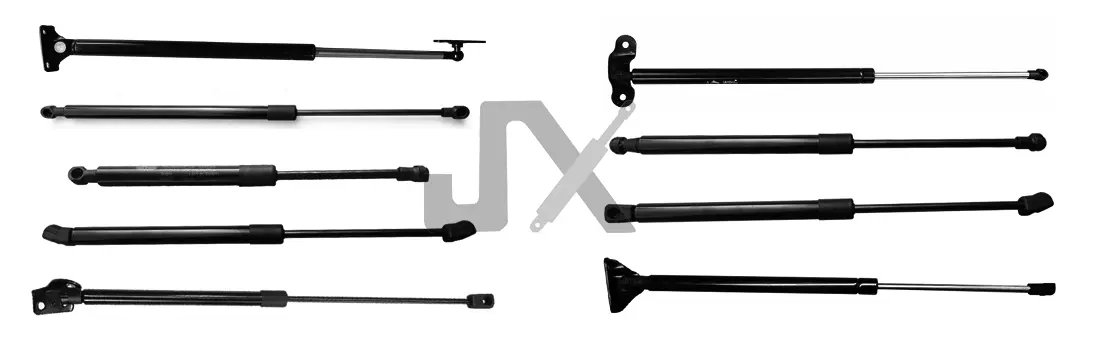
What Types of Bus Gas Springs Fit Luggage Doors and Engine Hatches?
Definition and Scope of a Bus Gas Spring
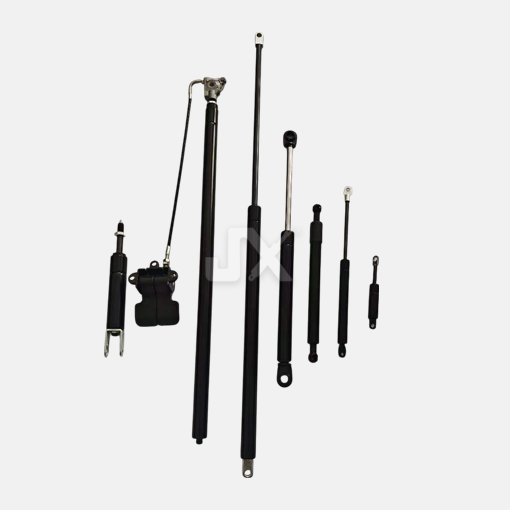
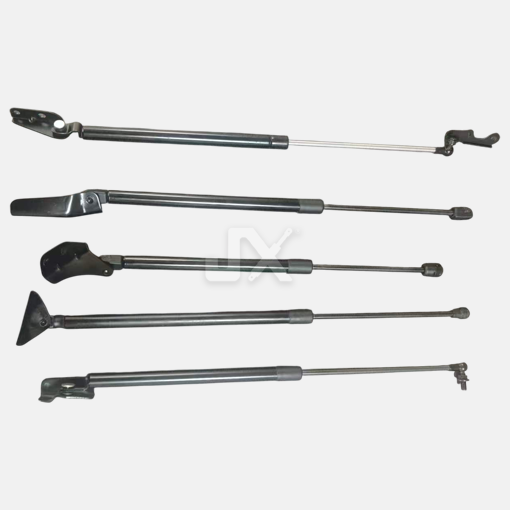
A bus gas spring is a sealed cylinder filled with pressurized nitrogen gas and equipped with a piston rod. The difference in pressure between the interior of the tube and the outside air pushes the rod outwards so the door has a controlled lift rather than a dead weight to deal with.
This portion seldom works by itself. This helps a hand-operated door, hatch or panel. Bus body builders include hinges, locks and occasionally a mechanical stay for added safety during servicing.
The typical unit consists of a pressure tube, a piston rod, a nitrogen charge, a seal system and two end fittings. Some variants include hydraulic damping fluid within the tube to provide a soft-close effect as the end of travel approaches.
Common Applications on Buses and Coaches
| Application | Typical function | Main selection concern |
|---|---|---|
| Luggage-bay door | Lifts and holds heavy side-access panels | High force, corrosion resistance, long cycle life |
| Engine access hatch | Supports rear or side engine covers | Heat tolerance and vibration resistance |
| Destination-board panel | Holds lightweight display covers open | Compact size, moderate force |
| Interior compartment cover | Positions service or storage panels | Low friction and smooth closing |
Gas Spring Variants Used in Coach Manufacturing
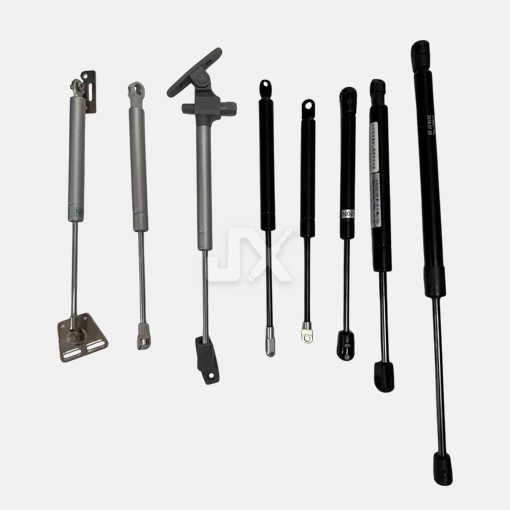
Fleet converters and distributors sometimes have many types next to each other. Here’s what each one solves:
- The normal constant force bus gas springs cover most of the baggage doors and engine hatches when the force needed is constant throughout the model run.
- Heavy-duty gas springs are used for broad baggage compartments on long-distance coaches when door weight is more than 15 kg per panel.
- Damped gas springs with nitrogen or hydraulic cushioning delay the last few centimeters of motion so you don't bang the hinges again and over.
- Lockable gas springs are important for ambulance and motorhome converters: they keep a hatch in a fixed open position for maintenance operations.
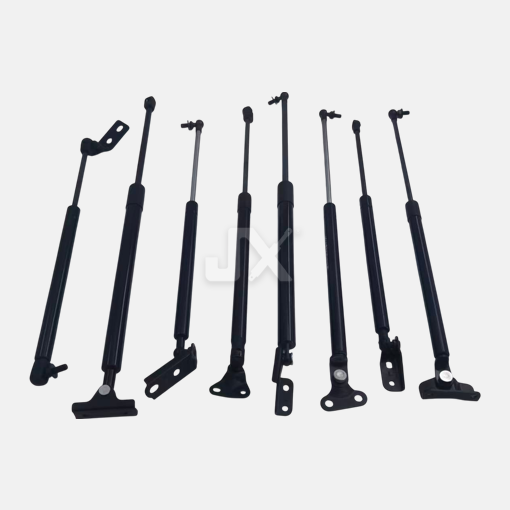
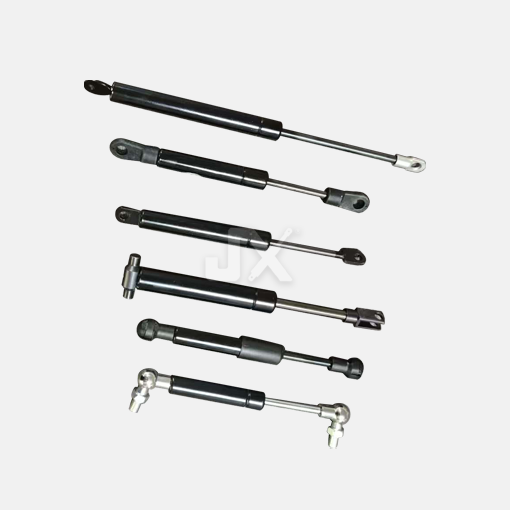
- Custom end-fitting gas springs – ball socket, eyelet, bracket, pin or stud – match the precise bracket geometry on a particular OEM component number.
These varieties execute distinct functions on the same vehicle, which means typically one coach model requires two or three different kinds of springs on its doors and hatches.
How Do You Calculate the Right Force for a Bus Gas Spring?
Basic Force Calculation
A workable starting formula is:
F ≈ (W × d) / (n × r × η) + Fs
In this formula, F is the force needed (N), W is the weight of the door, d is the distance from the hinge to the center of gravity of the door, n is the number of bus gas springs, r is the lever distance from the hinge to the line of force of the spring, η is the friction and geometrical losses. Fs includes a margin for seals, wind, and tolerance.
This figure is only a starting point. At Juxiang, our technical team constantly re-checks computed values against a physical prototype, since the leverage a gas spring exerts varies as the door swings over its arc.
How Mounting Geometry Changes the Outcome
Even if the catalog rating remains the same, there are a few factors that will change the effective force a spring will deliver:
- The placement of the hinge in relation to the weight distribution of the door affects the amount of lift needed from the spring at the initial degree of opening.
- How much of the rated force really gets converted to lift is dependent on the angle between the spring and the door panel.
- The static calculation does not take into account the resistance of wind loads on an open baggage door, such as during highway rest breaks.
- In the thousands of cycles, a tiny but actual part of the rated output is consumed in seal friction inside the spring itself.
A bus gas spring that is good when tested on a bench might fail to raise a door adequately if the angle of the installation is too near to the hinge line.
Verifying Force Data From a Supplier
A trustworthy supplier gives you more than one number. Ask for the table below before you commit to a production order.
| Parameter | What to verify |
|---|---|
| Nominal force | Measured at a defined temperature and stroke position |
| Push-out force | Initial extension force from fully compressed |
| Force tolerance | Usually ±10% unless a tighter spec is agreed |
| Temperature effect | Force change between -40°C and +80°C |
| Cycle retention | Force held after 50,000+ open-close cycles |
How Does Door Weight and Geometry Affect Gas Spring Selection?
Weight Distribution Matters More Than Total Weight
A hefty baggage door, whose center of gravity is near the hinge, may take less force to open than a lighter door with a large swing radius. I have seen distributors purchase the incorrect bus gas spring only by weighing the door and ignoring the center of gravity check.
Measure the whole door assembly including trim, latches, and insulation. Then identify where that mass balances around the hinge axis. That one measurement typically accounts for two doors of comparable weight having varying force ratings.
One Spring, Two Springs, or More
| Configuration | Advantages | Risks |
|---|---|---|
| One gas spring | Lower cost, simple install | Can twist the door under uneven load |
| Two matched springs | Balanced lift, less hinge stress | Needs matched left/right force curves |
| Multiple springs | Fits large luggage or split hatches | Higher tolerance control needed |
For wide coach luggage doors, two matched springs usually distribute the load better than one oversized unit. This is also why OEM buyers ask for paired samples with matched force curves before mass production — a mismatched pair creates a visible lean on the door.
A Quick Checklist Before You Confirm Weight Data
Before you lock down a specification, go over these points with your engineering contact or supplier:
- Make sure the specified door weight covers glass, trim, locks, and any insulation added during installation, which are sometimes left out of initial estimates.
- Record the position of the center of gravity. Do not assume that it is in the geometric center of the panel.
- If the bus is often driven on open roads or along coastal routes where crosswinds are considerable, wind loading should be considered.
- Do you want the spring to open the door entirely? Or do you just want it to hold the door? Or do you want it to only soften the last few inches of the door shutting?
What Length and Stroke Specifications Matter Most?
The Core Dimensional Relationship
Stroke = length extended minus length compressed. Measure from the center of one end fitting to the center of the other with the spring completely stretched and the spring fully compressed.
A new bus gas spring needs to be virtually precise to this stroke. If it's too short, the door won't open all the way. If it’s too long, the rod bottoms out before the hatch reaches its stop, and that puts pressure on the mounting bracket.
Ten Measurements to Record Before Ordering a Replacement
Before ordering a replacement, measure these points on the original part (not from a picture or an estimate).
- Overall center-to-center length
- Compressed length, center to center
- Stroke length
- Diameter of cylinder
- Rod size
- Thread size and kind of end fitting
- Diameter of mounting hole
- Bracket Direction
- Force rating
- Fully closed to fully open door angle of opening
Installation Clearance Checks
Before you put a new spring in place, be sure the rod never touches the door frame at any point of its movement. Make sure you don’t bottom out the spring before the door meets a mechanical stop, and that you don’t stretch it out while the door is fully open. Mounting brackets must also be strong enough to withstand the full reaction force during a forceful closing.
How Do Temperature and Climate Affect Bus Gas Spring Performance?
Operating Range Shapes Real-World Force
The gas pressure within the tube increases with heat and decreases with cold. A spring that feels just right in a warm workshop might seem lazy on a frigid morning in Almaty, or feel overpowering on a Dubai hot afternoon.
Our manufacturer rates the basic bus gas spring line from -40°C to +80°C, so you may have Siberian winters and Gulf-region heat without a design adjustment. “We developed this range with a rubber seal formula for cold-climate markets, as Russia and Central Asia are a large part of our export volume.
Field Data From Cold-Climate Testing
Units that we tested under internal cold-chamber settings showed pressure loss of less than 5% after twelve months of simulated operation at -40°C start-up conditions. This is important for Russian and Kazakh distributors, since EAC compliance paperwork frequently needs evidence of cold-start performance before customs clearance.
Weather Exposure Beyond Temperature
A spring set in an outside baggage door has more to contend with than heat and cold fluctuations. Service life will be shortened in cold areas by road salt, in tropical places by UV exposure, and in regular cleaning by pressure washing, if the finish isn’t constructed for it. Southeast Asian customers inquire specifically about humidity and UV protection before even minor trial purchases, because many units are in open-air depots.
Which Materials and Finishes Resist Corrosion Best?
Comparing Common Finish Options
| Material or finish | Advantages | Limitations | Best use |
|---|---|---|---|
| Zinc-plated steel | Low cost, decent protection | Weak against heavy salt exposure | Protected interior panels |
| Epoxy or powder-coated steel | Stronger surface barrier | Needs consistent coating quality | Exterior luggage doors |
| Stainless steel 304 | Good general resistance | Costs more than coated steel | Moderate coastal exposure |
| Stainless steel 316 | Best chloride resistance | Highest material cost | Coastal and winter-road routes |
Verification Before You Accept a Batch
Ask your supplier for the material grade, coating specification, and salt-spray test duration using ISO 9227 or ASTM B117 methods. A longer test duration is a good sign, but it's not a direct promise of field life — climate, mounting position, and cleaning habits all play a role too.
Compliance Notes for Different Export Markets
European purchasers usually need REACH and RoHS statements and third-party test results before they approve a new supplier. Russian and Central Asian customers are looking for EAC / TR CU certification and cold-start proof. These are not interchangeable – a REACH Declaration will not be enough to meet an EAC need, so check first which document set your target market truly requires before you start ordering.
How Do You Verify Mounting Compatibility and End Fittings?
Matching End Fittings to the Bus Structure
A bus gas spring will only operate if its end fitting fits the bracket it bolts into. Typical selections include ball sockets, eyelets, clevis forks, threaded studs, and pins with clips to keep them. Each one requires a precise angle of articulation so as not to side-load the rod.
Side loading is a very prevalent reason for early seal wear. The spring must be able to swing through the complete door swing; otherwise, the rod rubs against the seal at an angle it was not designed for.
A Practical Installation Sequence
Following a consistent setup sequence helps avoid return claims and warranty disputes. Here's the order our technical team suggests for distributors putting up new fitters:
- Check the force, length, stroke, and end-fitting type against the original part.
- Mechanically support the door prior to removing the old spring.
- Install brackets as shown on the authorized design, not by guess.
- Tighten. Make sure the spring is aligned with where it wants to go.
- No bending, no twisting, no side loading on the rod.
- Fully tighten the retention clips and locking hardware.
- Rotate the door carefully by hand and verify clearance everywhere.
Common Installation Risks
| Risk | Consequence | Fix |
|---|---|---|
| Wrong force rating | Door slams or won't lift | Recalculate and retest |
| Side loading | Premature seal wear | Realign brackets |
| Wrong stroke | Restricted opening | Recheck motion envelope |
| Weak brackets | Pull-out under load | Verify structural capacity |
What Safety Features Should You Require?
Controlled Movement and Locking Options
Safety-focused buyers — fleet operators, ambulance converters, body builders — often ask for damping near the end of stroke, mechanical stops, or lockable positions for maintenance access. A bus gas spring should never be the only thing holding a heavy hatch open while a technician works underneath it; a mechanical stay belongs in that system too.
Emergency Door Considerations
For emergency exit doors, check the manual opening force stays within a range passengers can realistically manage, including older or injured riders. Confirm the door's behavior if the spring loses pressure — it should still allow manual operation, not lock the exit shut. UNECE Regulation No. 107 covers general construction requirements for M2 and M3 category buses in many jurisdictions, so check which type-approval rules apply to your specific market before finalizing a design.
A Short Safety Verification List
Run these checks before signing off on any safety-related installation: test opening and closing force across full travel, confirm the door cannot drop unexpectedly under its own weight, inspect brackets after a load cycle test, and keep records for any application tied to passenger safety.
Why Do Bus Gas Springs Fail, and How Do You Prevent It?
Common Failure Causes
Most failures trace back to a short list of causes: seal wear from age or contamination, rod corrosion from salt or moisture, side loading from poor alignment, overloading beyond the rated force, or simple pressure loss over a long service life. A weak bus gas spring on one side of a paired set often shows up as an uneven, lopsided door swing before it fails completely.
Case Snapshot: A Central Asian Fleet Switch
An operator with 85 intercity buses operating across Kazakhstan has experienced repeated luggage-door failures during cold months, with some 18 per cent of its gas springs requiring replacement within two years after installation using a prior supplier's standard-grade units. Following the changeover to our cold-rated line, the operator’s maintenance team monitored failure rates over the subsequent 14 months, which dropped to around 4%, according to their internal fleet log provided to our export team. The key difference was the seal compound and better pressure retention management during gas filling—not a change in force rating or size.
As our product engineer Li Wei said in a client review call: “Most cold climate failures we see are not about the nitrogen charge; they are about the seal compound hardening before the gas does anything wrong.” That one statement changed how we describe rubber formulae for Russian and Central Asian orders coming in the future.
Maintenance Inspection Points
Fleet maintenance teams should check for oil or grease leakage, bent or scratched rods, corrosion on the coating, loose brackets, and uneven performance between paired bus gas springs during scheduled service intervals. Catching these early prevents a sudden door drop during loading or unloading.
How Do You Choose Between Wholesale Stock and Custom OEM Supply?
What Wholesale and Aftermarket Buyers Actually Need
Wholesale purchasers – importers with OEM cross-reference ranges, brand-specific distributors and online drop-ship sellers – are mainly concerned with piece pricing and container economics. “Quotes are compared FOB Tianjin or Qingdao, and benchmarked against Stabilus, Lesjofors, Suspa, KYB and others. If quality is consistent, we will change supplier for a few cents.”
These purchasers require standard stroke and force values available ex-stock or on a short lead time, boxes branded for warehouse barcode scanning, and predictable 30-45 day manufacturing plus sea freight. ERP-based production scheduling offers a typical lead time of 20-30 days, allowing wholesale partners to arrange container loads without guessing.
What Custom and OEM Buyers Actually Need
Custom OEM buyers — body builders, van converters, brand-specific distributors needing an exact match — care about engineering accuracy and confidentiality. They need custom stroke, custom force values, pressure tuning, and end-fitting options like [ball socket], [eyelet], [bracket], [pin], or [stud], backed by a signed NDA covering drawings and vehicle model lists.
Here's what we typically supply before these buyers approve mass production:
- First-article samples with matched left and right force curves, so paired bus gas springs lift evenly on both sides of a luggage door.
- Private-label packaging with a laser-etched or printed logo, supporting neutral branding for OEM and ODM programs.
- Batch test reports covering air-tightness, damping performance, and salt-spray results for every production run.
- Tooling ownership and supply continuity across a 3-5 year model cycle, which matters for buyers locked into a specific coach platform.
Regional Trade Habits Worth Planning Around
The buyers in each of our export locations operate under various rules of paperwork and logistics. Russian and CIS purchasers want EAC / TR CU certification and Russian language labeling and ship stock by train or truck via Manzhouli or Alashankou, generally with prepayment. South American customers in Brazil and Argentina often import-license via existing distribution channels, CIF price into Santos or Buenos Aires and Portuguese or Spanish labels. Southeast Asian customers prefer smaller trial purchases with quick re-supply and frequently rebrand under a local private label.
Why Full In-House Control Matters Here
Xingtai Juxiang Machinery Manufacturing Factory, established in 2002 in Xingtai, Hebei, has its own tube forming, piston-rod machining, gas filling, assembly, and testing facilities. We have 20 technical specialists who will handle any change in stroke, force, or connection type directly instead of being requoted via a subsupplier chain. The structure is a large part of the reason why we can guarantee the same force curve on order 40 as on order 1.
Conclusion
When selecting a bus gas spring, you need to look at the whole door system and not just a force value on a spec sheet. Weight distribution, mounting geometry, stroke length, temperature range, corrosion exposure, and safety behavior all interact, and if you miss any one of these, it usually shows up later as a maintenance nightmare. So whether you are loading a 40HQ container of regular stock, or testing out a bespoke bracket under NDA, the checklist is the same: check force against actual geometry, check climate rating against your market, ask for test results before the batch ships, not after.
FAQ
1. What is a bus gas spring?
A bus gas spring is a sealed pneumatic component filled with pressurized nitrogen that assists, supports, or controls the movement of luggage-bay doors, engine hatches, destination panels, and interior compartment covers on buses and coaches.
2. How do I calculate the force for a luggage compartment gas spring?
Use door weight, center-of-gravity distance, hinge geometry, mounting angle, and the number of springs installed. Treat the formula result as a starting estimate, then confirm it with a physical sample, since leverage changes as the door swings open.
3. What is the best gas spring for a bus engine hatch?
The right choice depends on hatch weight, available mounting space, heat exposure near the engine bay, and vibration tolerance. Engine hatches generally need a compact, heat-resistant spring with a reliable damping action near full extension.
4. Should I choose stainless steel or coated steel for bus gas springs?
Stainless steel, especially grade 316, suits coastal routes and winter-salt roads better than coated carbon steel. Coated steel works fine for interior panels or climates without heavy salt exposure, and it costs less per unit.
5. How long do bus gas springs last?
Service life depends on cycle count, temperature swings, mounting accuracy, and maintenance habits rather than a fixed number of years. Ask your supplier for cycle-test data specific to your application instead of relying on a generic lifetime claim.
6. Can a bus gas spring be repaired once it loses pressure?
No. Sealed gas springs are built as replacement parts, not repairable units. Drilling, heating, or dismantling a pressurized spring in the field creates a real safety hazard and should be avoided entirely.
7. Why do my left and right luggage door springs feel uneven?
Uneven lift usually means one spring has lost pressure faster than its pair, often from a seal issue or manufacturing variance. We recommend replacing left and right springs together as a matched set rather than one at a time.
Ready to Specify Your Bus Gas Spring Order?
If you're comparing supplier quotes for a wholesale container order or need a custom force curve under NDA, our team at JX can work from your OEM part number, a drawing, or a physical sample. We offer direct OEM replacement parts with no modification needed, a 50-unit MOQ, and a 2-year warranty backed by IATF 16949 and ISO 9001 production control. Reach out at jx@jxgasspring.com to request a quote or a force-curve sample for your next bus gas spring order.
References
1. International Organization for Standardization (2015). ISO 9001:2015 — Quality Management Systems. Referenced in the mounting compatibility and supplier verification sections. https://www.iso.org/standard/62085.html
2. International Organization for Standardization (2017). ISO 9227 — Corrosion Tests in Artificial Atmospheres, Salt Spray Tests. Referenced in the materials and finishes section. https://www.iso.org/standard/71243.html
3. ASTM International (2019). ASTM B117 — Standard Practice for Operating Salt Spray Apparatus. Referenced in the corrosion verification section. https://www.astm.org/b0117-19.html
4. United Nations Economic Commission for Europe (2023). UNECE Regulation No. 107 — Uniform Provisions for M2 and M3 Category Vehicles. Referenced in the safety features section. https://unece.org/transport/vehicle-regulations-1958-agreement
5. European Chemicals Agency (2024). REACH Regulation Overview. Referenced in the compliance notes section. https://echa.europa.eu/regulations/reach/understanding-reach
6. European Commission (2024). RoHS Directive 2011/65/EU and Amendments. Referenced in the compliance notes section. https://environment.ec.europa.eu/topics/waste-and-recycling/rohs-directive_en
About the Author
Zhao Ming is a Mechanical Engineer with over 15 years of experience in gas spring design, force-curve calculation, and automotive aftermarket quality control. He works on OEM/ODM development projects for commercial vehicle applications, including coach luggage doors, engine hatches, and tailgate systems, and has supported export quality programs across Russia, Southeast Asia, and Central Asia.