Agricultural Machinery Gas Spring
Integrated damping buffers bump impact in farmland, preventing violent collision and protecting machinery components.
Dustproof and anti-corrosion sealing, resistant to mud, moisture and pesticide in harsh farm working conditions.
Precision sealing reduces pressure attenuation, maintaining stable force during long continuous field operation.
Multiple fittings available for standard farm machinery and customized agricultural equipment.
Custom force and stroke for harvesting machines, tillage equipment and various agricultural facilities.Minimum Order Quantity (MOQ): 50PCS
Agricultural Machinery Gas Spring for Harvesters & Tractors — Engineered for Extreme Field Conditions
Agricultural Machinery Gas Spring handles motion control under constant vibration, chemical splashes and wide temperature swings on farm machines. Xingtai Juxiang Machinery Manufacturing Factory, which was established in Hebei, China, in 2002, manufactures these gas springs with extended lengths of 150–1500mm, strokes of 30–500mm, and forces ranging from 300N to 1500N. Designed for harvesters and tractors, they include built-in dampening, dustproof sealing, and anti-corrosion protection to provide dependable field performance between -40°C and +80°C.
What Makes an Agricultural Machinery Gas Spring Different from Standard Units?
Conventional industrial gas springs are designed for regulated interior spaces. Standard equipment just cannot withstand the abrasive soil particles, pesticide spray, fertilizer splash, and intense vibration cycles that agricultural equipment runs under.
A purpose-built Agricultural Machinery Gas Spring solves specific field pain points. It reduces operator fatigue when lifting heavy engine hoods repeatedly during maintenance. It prevents cabin doors and side panels from slamming shut due to sudden terrain shifts. It keeps protective covers open safely while workers reload seed drills under load vibration.
The key engineering difference lies in sealing, surface treatment, and damping calibration. Agricultural variants use reinforced NBR or Viton seal systems, chrome-plated or QPQ-nitrided piston rods, and precision nitrogen charging — all designed to maintain stable performance through thousands of field cycles.
Technical Specifications
| Parameter | Details |
|---|---|
| Extended Length | 150 – 1500 mm |
| Stroke | 30 – 500 mm |
| Force Range | 300N – 1500N |
| Piston Rod Diameter | Ø6 / 8 / 10 / 12 mm |
| Tube Outer Diameter | Ø15 / 18 / 22 / 27 mm |
| End Fittings | Ball joint, Eye, Clevis |
| Material | Seamless steel tube + Chrome-plated piston rod |
| Working Temperature | -40℃ to +80℃ |
| MOQ | 50 PCS |
Core Performance Advantages
Precision nitrogen charge and internal oil-based end-of-stroke dampening provide smooth and silent operation. Every cycle has steady, predictable movement instead of abrupt dips or pop-up rebounds.
The gas spring and the mechanical parts it supports are shielded from the influence of the terrain vibration by built-in dampening buffers. This is particularly important for combine harvesters that are moving quickly across rough terrain.
Reinforced multi-layer seal assemblies provide excellent sealing against mud, moisture, and pesticides. The force output you get at installation stays constant over extended field seasons because precision sealing also lessens pressure attenuation over time.
Whether you are functioning in a frosty northern morning or a midsummer harvest in a hot climate, the device will function thanks to its high and low temperature stability. Almost all agricultural operating situations worldwide are covered by the working range of -40°C to +80°C.
Your maintenance staff will not require specific equipment or training thanks to direct replacement and easy installation. The ball joint, eye, and clevis end fittings that are offered fit conventional agricultural machinery mounting points on the majority of harvester and tractor types.

Application Scenarios in Agricultural Equipment
Heavy tractor engine hoods require an Agricultural Machinery Gas Spring that can hold significant weight steadily in hot engine bay conditions. The chrome-plated piston rod and high-temperature seal system maintain full holding force even after the engine has been running for hours.
Combine harvester cabin windows and doors benefit directly from integrated damping, which prevents slamming caused by sudden terrain shifts or strong wind. Dust ingress is also reduced because the gas spring holds door seals in firm contact with the frame.
Seed drill and planter side panels present a particularly demanding use case. These panels must remain open during seed reloading while the drivetrain continues generating significant vibration. The abrasive soil environment also accelerates wear on any exposed rod surface — which is why chrome-plated or QPQ-nitrided rods are essential here, not optional.
Quality Control and Durability Testing
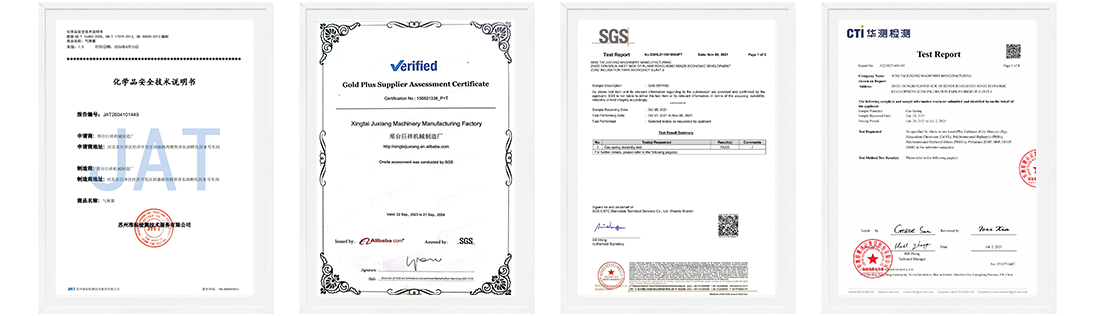
Before being sent, every unit must pass a series of performance tests. 30,000–50,000 compressions with less than 5% force loss are permitted during endurance cycle testing. Testing with salt spray verifies resistance to pesticide and fertilizer exposure. Damping testing guaranties consistent cushioning between batches. To facilitate assembly line installation and fleet component replacement, force tolerance is regulated within ±2N to 5% variation.
Customization and B2B Supply Capability
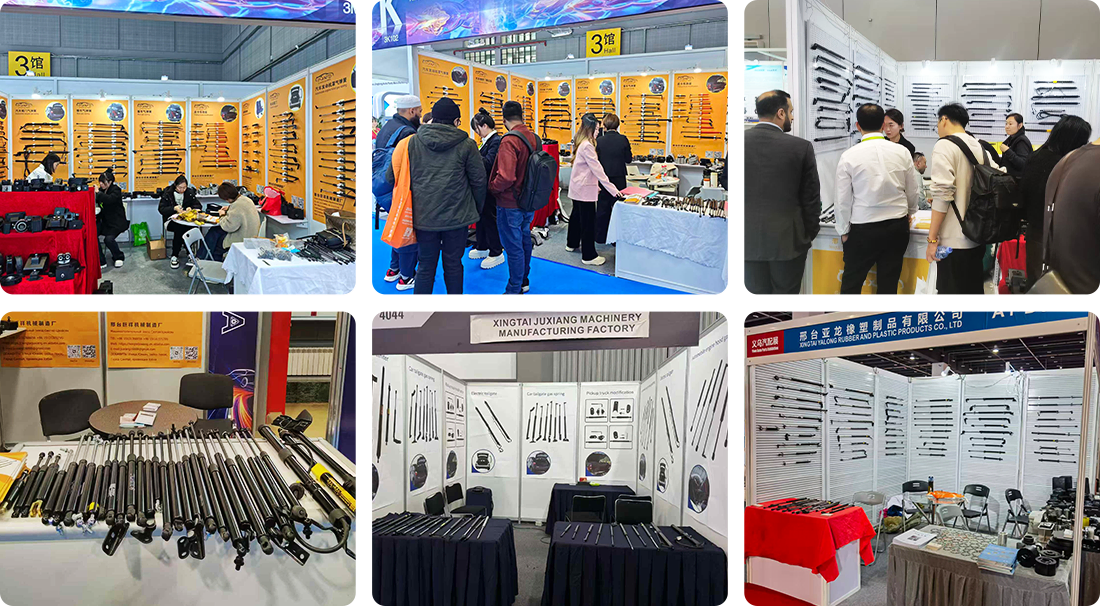
We adjust stroke, force and connector types for non-standard farm machinery. OEM and ODM orders are accepted with 50 PCS MOQ, available for small equipment makers and large procurement teams. With over 20 years of export experience, we arrange stable delivery to South America, Europe, Middle East and Southeast Asia.

FAQ
Q1: Why does force drop in cold weather?
A: Gas pressure falls at lower temperatures, roughly 3.4% force reduction per 10°C drop. Order with slightly higher nominal force for cold regions.
Q2: What is the recommended installation direction?
A: Mount with piston rod down in closed position. Internal oil keeps seals lubricated and maintains damping over service life.
Q3: How do these resist farm chemicals?
A: Chrome or QPQ-nitrided rod surface resists chemicals; multi-layer seals stop liquid entering the cylinder.
Q4: What causes early failure in field use?
A: Common causes are side load from misaligned mounting, scratches on piston rod, or temperature over 80℃. Proper alignment extends service life.
Q5: Can we customize force and stroke?
A: Yes, we can set custom force and supply different end connectors to match machine geometry. MOQ for custom items is 50 PCS.
Contact Us
Ready to source reliable agricultural gas springs for your equipment with Agricultural Machinery Gas Spring? Send your specifications to jx@jxgasspring.com and our technical team will respond promptly.