Tailgate Gas Spring vs Lift Support: What Is the Difference for Trucks
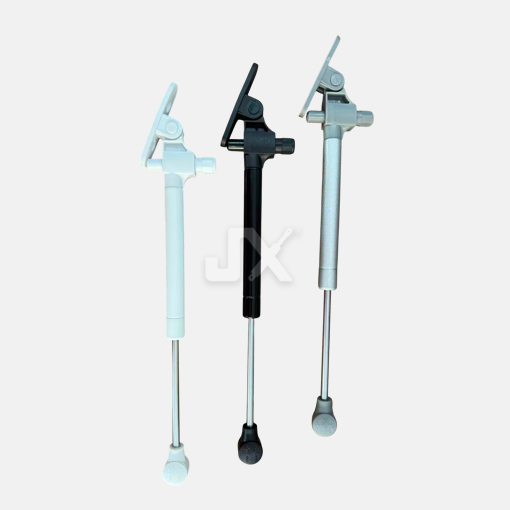
A tailgate gas spring is a kind of lift support that is designed to help and manage the back door of a car. Lift support is a broader category that also includes struts for hoods, trunks, cabinets, and equipment doors. This tutorial explains the genuine differences in force, fitting, geometry, and material so you can choose the proper part for a truck, wagon, van, or camper rear door. It also has sourcing, testing, and installation stages to minimize fitting mistakes and warranty claims.
Tailgate gas springs are sealed steel tubes filled with compressed nitrogen that help lift and support truck and wagon tailgates. Their performance depends on panel weight, hinge geometry, mounting angle, extended length, stroke, and force rating. Heavy-duty versions suit service bodies and refrigerated vans, but excessive force can make closing difficult and strain hinges. OEM and aftermarket springs are interchangeable only when key specifications and fittings match. Common failure signs include weak lifting, uncontrolled closure, oil leakage, rust, and bent rods; worn springs are generally replaced in pairs. Accurate measurement and supplier documentation, including force test and salt-spray data, can reduce fitting problems, returns, and warranty disputes.
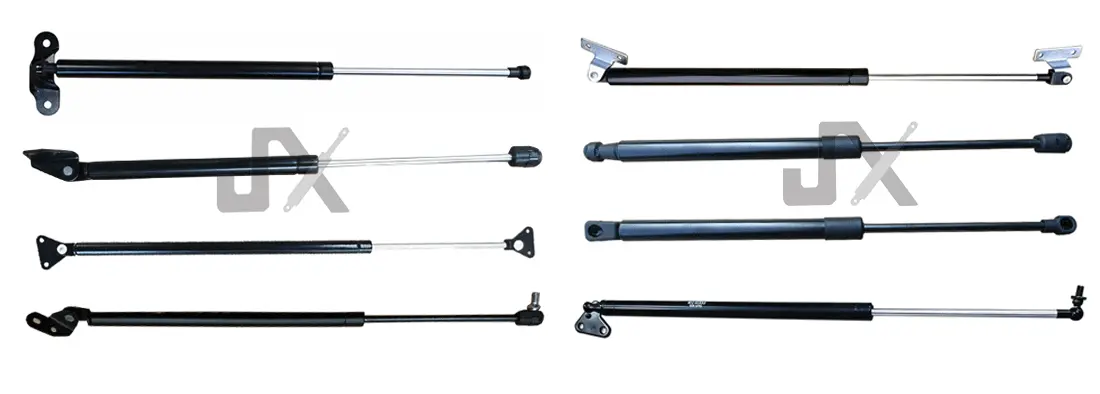
What Is a Tailgate Gas Spring?
Tailgate Gas Spring Definition
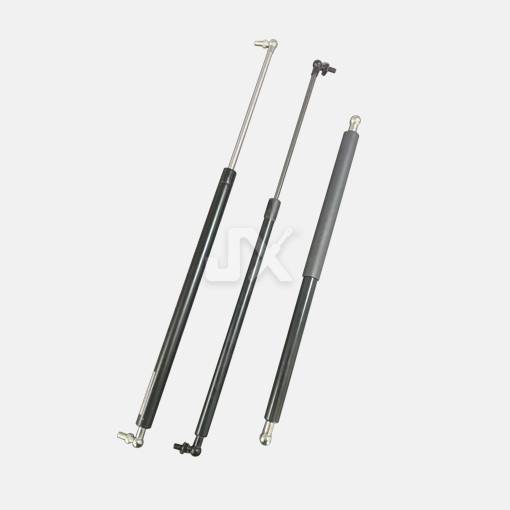
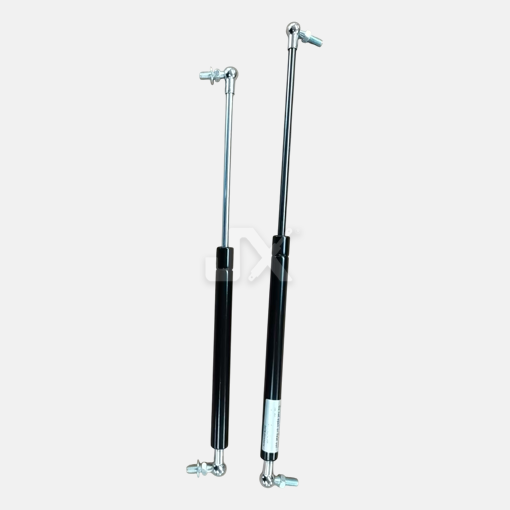
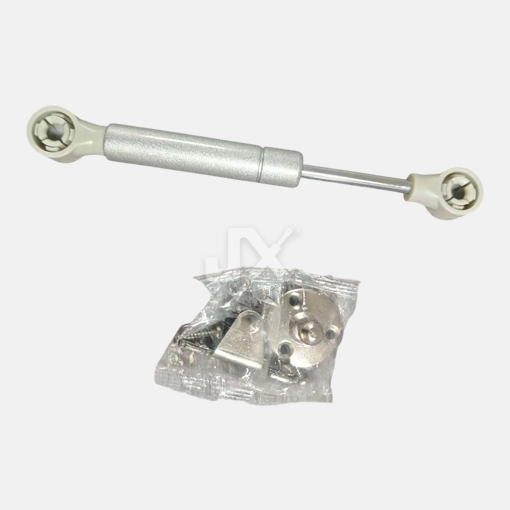
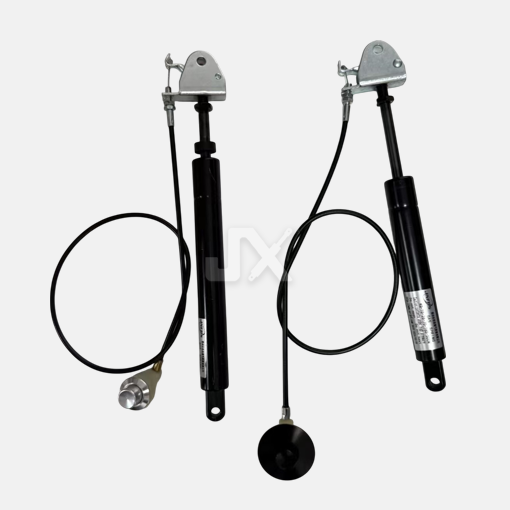
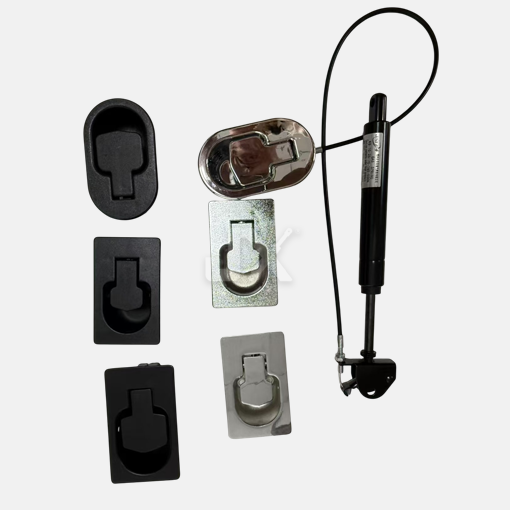
A "tailgate gas spring" is a cylinder that is sealed and filled with nitrogen gas that has been compressed. It is made up of a piston, a piston rod, seals inside, and holes on both ends. One end goes on the car's body, and the other end goes on the hatch or trunk. The spring helps support some of the panel's weight and makes it move more slowly by having built-in damping. This keeps the tailgate from dropping when it opens or closes. It's not just a lock, an electric lift mechanism, or a simple metal prop rod. This part doesn't hold the door shut by itself; it just helps move things.
Common Tailgate Gas Spring Applications
Most of the same tailgate gas springs are used on truck tailgates, tonneau coverings, and SUV rear doors all over the globe. Vans, ambulances, refrigerated box trucks, and motorhome conversions all use the same basic design for their rear doors and side panels. People who switch fleets and build camper shells or cold units typically want a stronger and more damped version. This is because insulated panels weigh more than normal sheet metal. “OEM part numbers, standard aftermarket replacements, and units cut to length for body builders are essentially the same thing.” The only difference is that the stroke and force numbers are set to different amounts.
Main Components and Specification Terms
Parts that don't fit are given to people who don't read the spec sheet. The table below shows the terms that you will find on any tailgate gas spring information sheet.
| Term | What It Means |
|---|---|
| Extended length | Overall center-to-center length when the tailgate is fully open |
| Compressed length | Center-to-center length when the tailgate is closed |
| Stroke | The travel distance between extended and compressed length |
| Tube diameter | Outer diameter of the gas-filled cylinder housing |
| Rod diameter | Diameter of the piston rod; affects buckling resistance |
| Force rating (N) | The push force delivered, measured in newtons at a set temperature |
| Mounting angle | Angle between the support and the panel at open and closed position |
| End fitting | Ball socket, eyelet, bracket, pin, or stud connecting the spring to the vehicle |
| Damped / non-damped | Whether the spring slows motion near the end of travel |
It's important to know these words. If there is a difference of one millimeter in rod thickness or ten newtons in force rating, a "direct fit" part can turn into a return.
How Does a Lift Support Work on Trucks?
Gas Pressure and Mechanical Assistance
If you compress nitrogen gas, it pushes on a piston that can move within a door tailgate gas spring. This pushes the piston rod forth with a force when the latch unlocks. The force varies a little during the stroke, depending on where the rod is, how hot the room is, and how much friction there is in the seal. It could feel a little different when it is hot in Dubai and when it is freezing in Almaty. This is the reason why purchasers shipping to these locations must ensure that the tests are conducted from -40°C to +80°C.
The Role of Geometry and Mounting Position
In all respects, the placement of the hardware influences the performance of a support. JX engineers tested 40 different kinds of cars and discovered that the amount of force required to move the bracket was about 18% different when it was only 20 mm closer to the hinge. That alone tells you how crucial form is, combined with the weight of the panel, when you are choosing a door gas spring. Two gas springs on van doors that are widely apart may push less than a single strut in the center, which can bear the whole weight. The force exerted on the panel depends on the distance from the hinge to the point where the lever arm is connected.
Gas Spring Versus Mechanical Tailgate Support
Back doors don't always have a nitrogen gas spring. The different kinds of truck and car frames are shown below.
| Support type | Operating principle | Advantages | Limitations |
|---|---|---|---|
| Nitrogen gas spring | Pressurized cylinder assists movement | Smooth, compact, controlled motion | Force can drop with leakage or temperature swings |
| Mechanical support rod | Rigid bar holds or limits load | Simple, low cost, no gas pressure to lose | Manual operation; pinch risk during storage |
| Torsion spring | Spring built into the hinge | Compact and durable in matched designs | Needs application-specific engineering |
| Electric lift actuator | Motor-driven opening and closing | Remote and automated operation | Higher cost; wiring and service complexity |
For most camping, wagon, and light-duty van tailgates, the nitrogen gas spring is still the best option. It's not wired and can handle the wide range of weather that most export markets see.
Tailgate Gas Spring vs Lift Support: What's Different?
Terminology: Tailgate Gas Spring, Gas Strut, and Lift Support
Things on lists don't always agree on what to call them. "Lift support" refers to any gas-filled strut, while "gas strut" and "tailgate gas spring" most often mean the same thing. What's wrong is that just because names match doesn't mean that dimensions or power will also match. Even if a hood strut and a rear strut have the same catalog number, they may have very different strokes, hole sizes, and forces.
Technical Comparison
| Criteria | Tailgate gas spring | General lift support |
|---|---|---|
| Typical application | Pickup tailgate, SUV hatch, utility door | Hoods, trunks, seats, cabinets, machinery, doors |
| Design priority | Tailgate weight, opening angle, road vibration | Application-specific load and motion |
| Common fittings | Ball sockets, eyelets, brackets | Many fitting and mounting styles |
| Force selection | Based on tailgate mass and leverage | Based on component load and geometry |
| Replacement method | Vehicle-specific or measured aftermarket part | Application-specific identification needed |
Heavy-Duty, OEM, and Aftermarket Differences
Those purchasing in bulk will typically verify the stated tailgate gas spring against cross-reference numbers from Stabilus, Lesjofors, Suspa or KYB before ordering. When you purchase by container, it's normally the price per piece after the force and size concerns are sorted out. It is more crucial to match the force curve to within 5% of the original equipment component than the brand name on the box. The walls of the tubes are thicker, and the rods are larger, which makes heavy-duty versions more expensive and takes longer to construct. Stainless steel tubes are excellent for shipping refrigerated vans, ports in Southeast Asia, and routes in West Africa because they can tolerate salt spray from the sea and humidity near the coast better.
Which Option Is Better for Truck Tailgates?
When a Tailgate Gas Spring Is Usually Suitable
Some pickup and SUV hatchbacks can use a standard tailgate gas spring as long as the hinge geometry is clear and the weight needs to be lifted. It can also be used for replacement jobs where the mounting points from the old one are still good, and there is no need for an electric lift. Most independent repair chains and 4S-equivalent service groups keep this standard setup on hand because it can be used for most walk-in replacements without the need for special tools.
When a Different Support May Be Better
For very large tailgates on service bodies, a support with more than one point is sometimes better than a single center spring. If your car's door already has electric motors, torsion bars, or lines built in, you should not change those parts. Instead, just add a simple gas spring. Instead of a standard-grade part, a tested heavy-duty or stainless version is needed when there is a lot of corrosion, high heat, or rental cars that open and close all the time.
Use-Case Decision Checklist
Depending on what role they play, buyers make this choice in various ways. The table below shows what each type of buyer should look at first.
| Use case | Recommended evaluation focus |
|---|---|
| OEM vehicle program | Drawing data, validation testing, inspection records, traceability, controlled change management |
| Distributor or importer | SKU coverage, carton labeling, MOQ, lead time, warranty terms, fitment data |
| End-user or repair shop | Exact dimensions, force rating, fittings, safe removal steps, corrosion condition |
Can One Gas Spring Replace a Lift Support?
Conditions for Interchangeability
A new part will only work if a number of conditions are met. These include the length when stretched and when compressed, the stroke, the force rating and tolerance, the rod and tube diameter, the type of end-fitting, the mounting angle, and the temperature range that the part is rated for. A cheap swap could turn into a second warranty claim if you miss even one of these. Even though a 150N and a 180N tailgate gas spring look the same, they are not the same. If you compare them, you will notice that the tailgate opens and closes in different ways.
Risks of Using an Incorrect Replacement
It virtually never breaks the first day you put on the incorrect part. Weeks of usage will reveal the injury when the panel sags, the clasp gets too heavy, or the rod bends side to side unevenly. If you can't keep the tailgate open, it is risky to load. If it shuts too rapidly, you might harm your fingers or bend the hooks. Sometimes, you receive the same support request loaded with complaints again, as early as 90 days after purchasing something, from folks who didn’t check it out.
Verification Before Substitution
Verify the item fits better by cross-referencing the original part number with the vehicle fitting information. Better to measure the fixed support yourself rather than trust an image from a catalog. Look for one support in the center or two on the sides of the automobile. The force used is varied for each arrangement. Verify that the load has changed since the vehicle left the factory because of an additional cushion, a spoiler on the trunk lid, or a rear camera. This stage is extremely crucial if you have a fleet and are modifying ambulances, refrigerated vans, or RVs, typically adding additional weight.
How Do You Choose the Right Size and Force for Your Truck Tailgate?
Basic Force-Selection Principles
The weight of the vehicle affects force selection, but it also affects the mass, center of gravity, hinge position, support location, and opening angle of the tailgate gas spring. When engineers talk about force, they mostly use newtons. They only switch to pounds-force when a customer asks them to. It's not possible to get an exact number with this method:
To find it, divide (W × L_load) by (n × L_support).
What does W mean? It's the force of the weight on the back gate. The length L_load is the distance between the hinge and the weight center. The useful support lever arm is denoted by L_support. n is the number of backs. It measures how well form and friction work together.
Force-Selection Checklist
Take a look at a real car, not just a list of specs, before setting a force number.
| Checklist item | Why it matters |
|---|---|
| Verified tailgate mass | Wrong mass input throws off every force calculation downstream |
| Added accessories or payload | Spoilers, cameras, and liners shift the center of gravity |
| One-support vs two-support setup | Changes the force split per unit significantly |
| Opening angle and mounting geometry | Alters the effective lever arm at full extension |
| Field validation on a sample unit | Confirms real opening and closing effort before mass production |
How to Measure a Tailgate Gas Spring
- Secure the tailgate with a mechanical prop before removing anything.
- Measure the center-to-center length when fully extended.
- Measure the compressed length if it can be done safely.
- Subtract the compressed length from the extended length of the tailgate gas spring to get the stroke.
- Measure tube diameter and piston-rod diameter with calipers.
- Record the end-fitting type, ball size, and thread dimensions.
- Note the mounting orientation and whether one or two supports are used.
- Read the force marking on the tube, or request the original spec sheet.
Tailgate Gas Spring Size Guide
| Specification | Why it matters |
|---|---|
| Extended length | Sets the full-open geometry of the tailgate |
| Compressed length | Prevents the rod from bottoming out or hitting the body |
| Stroke | Controls how far the tailgate travels |
| Force rating | Decides how easy the tailgate is to lift and close |
| Rod diameter | Affects strength and resistance to bending |
| Tube diameter | Supports internal pressure and long-term durability |
| Fitting type | Confirms a secure, correctly oriented mount |
| Open/closed angle | Confirms the real direction of applied force |
Common Measurement Mistakes
| Mistake | Result |
|---|---|
| Measuring overall length instead of center-to-center | Wrong stroke calculation |
| Ignoring the original fitting orientation | Rod binds or installs backward |
| Matching by vehicle model only | Misses tailgate modifications or added weight |
| Replacing one worn support, leaving the other | Uneven lift and closing speed |
| Measuring a stretched or damaged part | Locks in an already-wrong spec |
How Do You Check Gas Spring Compatibility? Supplier Capability & Evaluation
Supplier Evaluation Criteria
A good company that sells tailgate gas springs should be able to show that they can change the length, force, stroke, and fitting. They should also be able to give you written specs for the material and coating. Ask for records of the force, leakage, cycle life, and corrosion tests that are linked to specific lot numbers, not just marketing sheets. Private-label buyers need to make sure they have the right tools and can get help packing before they sign an NDA that includes maps and lists of car models.
Our Factory Profile and Capability
Xingtai Juxiang Machinery Manufacturing Factory was established in 2002 in Xingtai, Hebei Province. Now about 100 individuals work there, including 20 technical and managerial professionals. We produce and design our own electric door hinges and gas springs. A way to build tubes and rods is to fill them with gas, put them together, and see whether they operate perfectly. If a unique stroke, force value, or link adjustment is required, the firm will take care of it itself and not ask for estimates from subcontractors again. We manufacture our products using quality systems certified to ISO 9001 and IATF 16949. They also fulfill the criteria of GB/T 25751-2010, QC/T 207-2021, and ISO 11982. Every batch is examined to make sure it does not allow air in and has appropriate damping.
Our rubber seal solution is UV light resistant and functions effectively at temperatures between -40’C and +85’C. It also does not lose more than 5% of its pressure during a year of usage, which is significant for those shipping to Russia and Central Asia. We ship to South America, Russia, Europe, the Middle East, Africa, Central Asia, and Southeast Asia, just to name a few. We have users in all of these areas, and we have over 5,000 models. For instance, a Central Asian dealer in Almaty converted to a matched-pair tailgate gas spring arrangement with JX in 2023. In two shipping cycles, sharing their own claims record during a seller evaluation reduced the proportion of returns owing to warranty from 9.4% of units sold to 3.1% of units sold. To remedy it, the left and right force curves were required to be within 5% of each other, and Russian-language box labels had to be inserted to pass EAC paperwork requirements.
A top test engineer on our quality team named Li Wei said, "Most of the time, the products that come back are not ones that don't work." "They trace back to a buyer matching a part number without confirming stroke and force against the actual installed geometry."
Procurement, Compliance, and Documentation Checklist
It's important for teams that buy things to have clear answers before they can approve a new supplier. In the table below, you can see the questions that are asked most often during container-level sourcing.
| Procurement factor | Questions to document |
|---|---|
| MOQ | Does standard stock differ from custom parts? Ours starts at 50 units per SKU |
| Lead time | What are sample, tooling, and production lead times? Ours runs 20-30 days |
| Payment terms | Are deposits, open account, or letters of credit available? |
| Incoterms | Is the quote based on EXW, FOB, FCA, CIF, or DAP? |
| Warranty | What failure modes and period are covered? We offer a 2-year warranty |
| Documentation | Are drawings, declarations, and inspection reports available? |
| Packaging | Are barcode labels, export cartons, and pallet specs supported? |
| Traceability | Can lots, raw materials, and inspection records be traced? |
Standards and Regulatory Considerations
This is a quality management systems standard published by the International Organization for Standardization in 2015. This is used for qualifying suppliers. Salt-spray tests are used to determine if something will not rust and are detailed in ISO 9227 and ASTM B117. But the buyer still has to decide how long the test will continue and what the criteria for acceptance are. When components or materials enter the EU supply chain, they must have RoHS and REACH declarations prepared (European Commission, 2011; ECHA, continuing). To be confident of compliance, you should ask for current statements. Most of the time, a passive automobile tailgate gas spring that functions by itself does not need to be CE marked. However, verify whether the completed product has a distinct duty. People in the U.S. may utilize resources from the National Highway Traffic Safety Administration (NHTSA) to find out about the regulations that apply to them and the items they are buying. These pages discuss marking regulations, supplementary components, and automobiles.
How Do You Install a Tailgate Gas Spring?
How to Remove a Tailgate Gas Spring
Use your hands to hold the door in place before you open any of the fittings. There are various types of fasteners that can be used in sockets. Each one opens in a different way, so check to see which type it is. It is important to release the fitting the way the maker meant it to be released. Do not cut, poke, heat, or take the compressed cylinder apart. Fix any broken brackets or ball studs before you put the new support in place.
How to Install a Tailgate Gas Spring
- Confirm the replacement's length, force, fittings, and orientation against the old part.
- Lay the new unit next to the removed one and compare directly.
- Install brackets or ball studs to the specified torque.
- Attach tailgate gas spring fittings straight on, without side-loading the rod.
- Fit paired supports together where the vehicle uses two.
- Cycle the tailgate slowly and watch for interference.
- Confirm smooth opening, controlled closing, and secure retention at both ends.
Installation Risks and Mitigation
| Risk | Mitigation |
|---|---|
| Tailgate falls during removal | Use a secondary mechanical prop and two-person handling |
| Incorrect orientation | Follow the supplier's rod-down or rod-up guidance |
| Pinched fingers | Keep hands clear of hinge and closing zones |
| Fitting detachment | Confirm clips, studs, pins, and torque after install |
| Over-force damage | Verify force and geometry before repeated cycling |
When Should You Replace a Tailgate Gas Spring?
Symptoms of a Bad Tailgate Gas Spring
| Symptom | Likely cause |
|---|---|
| Tailgate won't stay open | Lost gas pressure or worn seal |
| Fast or hard closing | Weak damping or internal leak |
| Oil residue near the rod | Seal failure |
| Bent or pitted rod | Impact damage or corrosion |
| Uneven movement side to side | One support worn more than the other |
Inspection and Quality-Verification Steps
First, touch the rods, tubes, seals, fittings, and clamps and feel for any fractured areas or loose bolts. For the lift to operate effectively, both supports need to have the same length, have the same force markings, and be in excellent condition. If possible, look at the inspection report, completion test record, and lot number. Parts returned under warranty must include the vehicle name, part number, date of installation, and kind of failure.
Replacement Timing and Failure Prevention
You should replace a tailgate gas spring as soon as it stops operating properly if leaks can be noticed, not after it has failed altogether. If testing indicates one side is still okay, replace both supports at the same time when they are similar age and have been used the same number of times. Usually bad side loading, bad force, or being exposed to extreme temperatures. Same automobile, again and again. “Not a bad batch. Keep spare units in a clean and dry place, and protect rods from dust and damage until required.
Conclusion
Someone who lifts things up might use a "tailgate gas spring." A "lift support" is a set of legs that are used on many items. There is more to a substitute than just its name. You should also look at its strength, length, stroke, fittings, geometry, and environmental grade. Distributors, fleet converters, and OEM teams should look at test records, traceability, warranty terms, MOQ, and delivery conditions of a new supplier before approving them for their area.
FAQ
1. What is a tailgate gas spring?
A pressure nitrogen spring called a tailgate gas spring helps open and close the tailgate of a truck or SUV. It might be known as a lift support or a door brace too.
2. Is a tailgate gas spring the same as a lift support?
One type of lift support that is often used is a tailgate gas spring. A "lift support" can also be a part for a door, trunk, hood, seat, closet, or industrial door.
3. How do I measure a tailgate gas spring?
Stretch it out and measure it from center to center. If it's okay, measure it while you squeeze it. Note down the stroke, the power grade, the number of supports, the sizes of the rods and tubes, and the end fittings.
4. Can I use a universal gas spring on a truck tailgate?
A universal gas spring will only work on a certain car if it has the right amount of power, size, fittings, stroke, and shape. Model matching isn't enough by itself; you also need to take measurements or do technical checks.
5. Should tailgate gas springs be replaced in pairs?
At times, it is safer to replace both supports at the same time. This is especially true if they are about the same age and have been used a lot. This makes sure that both sides of the opening and closing are safe.
6. What causes a tailgate gas spring to fail?
Most of the time, it's because of seal breaks, rust, rod damage, side loading, using the wrong force, heavy cycles, and being exposed to high or low temperatures for a long time.
7. Are stainless steel gas springs better than coated steel ones?
Stainless steel doesn't rust as quickly near water, the coast, or on roads that are wet in the winter. Coated steel can still be used for less money in places where the weather isn't too bad.
Get a Verified Tailgate Gas Spring Quote From JX
If you want to choose between a standard lift support and a proven tailgate gas spring, you don't have to guess. There are more than 40 countries where JX sells its tailgate gas springs to fleet converters, private-label sellers, and wholesalers. It does this as Xingtai Juxiang Machinery Manufacturing Factory. To do this, they make OEM-spec and unique units. To get a price and a force-curve match, email jx@jxgasspring.com with your part number, drawing, or example. As few as 50 units of each SKU are needed to meet the MOQ.
References
1. International Organization for Standardization (2015). ISO 9001 — Quality management systems — Requirements. https://www.iso.org/standard/62085.html — cited under Supplier Evaluation Criteria and Standards and Regulatory Considerations.
2. International Organization for Standardization (2017). ISO 9227 — Corrosion tests in artificial atmospheres — Salt spray tests. https://www.iso.org/standard/69604.html — cited under Standards and Regulatory Considerations.
3. ASTM International (2019). ASTM B117 — Standard Practice for Operating Salt Spray Apparatus. https://www.astm.org/b0117-19.html — cited under Standards and Regulatory Considerations.
4. European Chemicals Agency (ongoing). REACH Regulation and Substances of Very High Concern. https://echa.europa.eu/regulations/reach/understanding-reach — cited under Standards and Regulatory Considerations.
5. European Commission (2011). RoHS Directive 2011/65/EU. https://environment.ec.europa.eu/topics/waste-and-recycling/rohs-directive_en — cited under Standards and Regulatory Considerations.
6. National Highway Traffic Safety Administration (2024). US Vehicle Safety Regulations and Defect Reporting. https://www.nhtsa.gov/laws-regulations — cited under Standards and Regulatory Considerations.
About the Author
Li Wei, Technical Director at Xingtai Juxiang Machinery Manufacturing Factory, specializes in gas springs, lift supports, and automotive door support systems. With extensive experience in product engineering and quality control, Li Wei focuses on gas spring force selection, mounting geometry, material performance, durability testing, and OEM replacement solutions. He works closely with automotive parts distributors, fleet converters, and OEM customers to develop application-specific gas spring solutions for tailgates, hoods, trunks, and vehicle doors. Through practical manufacturing experience and technical evaluation, Li Wei provides reliable guidance on product specifications, compatibility, testing, and procurement, helping buyers reduce fitting errors, premature failures, and warranty risks.