Hood Gas Spring
Performance: Nitrogen/hydraulic damping for smooth soft-close; anti-corrosion finish; works from -40°C to +80°C; resistant to rain, snow, and salt spray.
Maintenance-Free: Self-lubricating design, no upkeep required over its long service life.
Pair Replacement Advised: Replace both left and right sides together to ensure balanced load distribution.
Tool-Free Installation: Comes with pre-installed end fittings; installs without special tools.
Customization Options: Length, pressure, end fittings, branding, and packaging all available for customization.
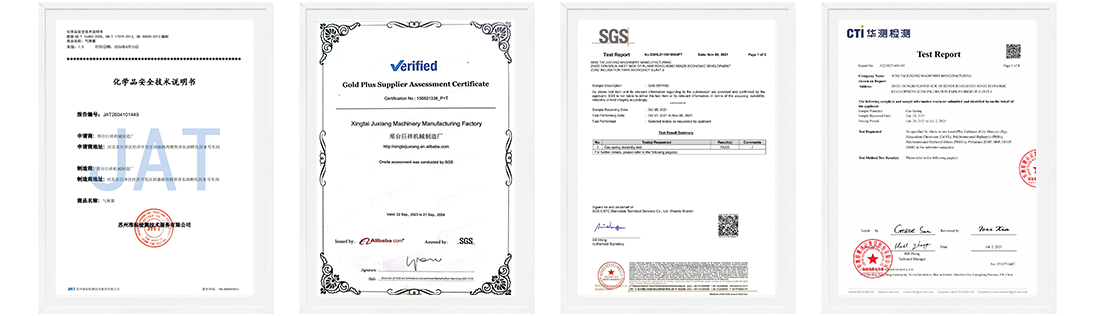
Certifications: IATF 16949 and ISO9001 certified.
Minimum Order Quantity (MOQ): 50PCS.
Hood Gas Spring for Automotive & Industrial Applications — Precision-Engineered Lift Support Solutions
With more than 20 years of production experience and a staff of 20 technical experts, Xingtai Juxiang Machinery Manufacturing Factory has focused on gas spring manufacturing since 2002. QPQ-treated piston rods and seamless steel tube cylinders make up our Hood Gas Spring. The operating temperature range is between -40°C and +80°C. Each ISO 9001 and IATF 16949 certified device provides reliable sealing performance, uniform force output, and a maintenance-free service life. It is made to satisfy OEM matching specifications and perform reliably in harsh operating environments worldwide.
What Is a Hood Gas Spring and How Does It Work?
Hood Gas Springs are hydropneumatic devices with fine motion control. It consists of a piston rod, a sealed pressure cylinder, and a particular arrangement of internal valves. Compressed nitrogen and regulated hydraulic damping via an internal oil circuit produce the lift.
This combo addresses actual issues that professionals and car owners are worried about. It eliminates the requirement for manual prop rod support of the hood, which can be pushed out of position, lessens the physical strain required to raise huge engine covers, and prevents the hood from slamming uncontrolled, which can eventually lead to hinge degradation. The end product is an ergonomic and safe automatic lifting system.
Key Product Features and Performance Advantages
There are many useful applications for this component. The distinction is that this
Silent and Easy Operation
Because of the integrated hydraulic and nitrogen dampening system, your hood will open steadily and close gently without sudden drops or jerky actions. Silent, no effect on completing the journey.
Resistance to Weather and Corrosion
The sealed cylinder and QPQ-treated piston rod finish provide resistance against rain, snow, salt spray, and humidity. Because of this, cars are dependable in coastal, tropical, and frigid regions.
Self-lubricating design that requires no maintenance
For the duration of the unit is life, the internal seal and lubrication system require no maintenance. You might forget it once it is installed.
OEM-Spec Direct Fit
The modifications are not required. The device already has end fittings installed, so no further tools are required for installation. This is intended to be a direct replacement for specific car models.
Equitable Distribution of Loads
Replacing the left and right sides together is highly recommended. In addition to preventing uneven hood movement and early wear on one side, this will help to ensure even force distribution.

Technical Specifications
| Parameter | Details |
|---|---|
| Material – Cylinder | Seamless steel tube |
| Material – Piston Rod | QPQ-treated surface finish |
| Working Temperature | -40°C to +80°C |
| Force Range | 100N to 1000N+ (application-dependent) |
| Seal Material | NBR / Viton high-grade seals |
| Gas Medium | Compressed nitrogen |
| Vehicle Fitment | OEM model-specific fit |
| MOQ | 50 PCS |
| Certifications | IATF 16949 / ISO 9001 |
| Customization | Length, force, fittings, branding, packaging |
Quality Control Standards You Can Rely On
Before any unit leaves the plant, it must pass a stringent multi-stage testing procedure. This is how consistent quality is maintained throughout each production batch; it is not merely a formality.
To pass the force deviation test, the extension force (P1) must be within ±5% of the design specification.
Fatigue Life Cycle Testing: Each unit is tested for 30,000 to 100,000 operation cycles in order to simulate a full product lifespan.
Salt Spray Resistance Testing: Based on ISO 9227, units are evaluated for corrosion resistance on both the rod plating and cylinder coating.
High/Low-Temperature Storage Testing: Gas pressure stability and seal integrity are verified after prolonged exposure to both extremes of temperature.
Damping Velocity Check: End-of-travel speed is evaluated to make sure hydraulic buffering prevents impact damage.
The performance metrics that are most important to workshop managers and B2B procurement teams are explicitly reflected in these tests.
Application Scenarios Across Industries
The engineering flexibility of this product makes it suitable for a wide range of real-world applications.
Passenger and Luxury Vehicles
For a comfortable driving experience, smooth, quiet operation and soft tight damping are key. For OEM manufacturing lines or aftermarket replacements, the units regularly deliver on expectations.
Trucks – Heavy-Duty & Commercial
Large and heavy hoods must be held open safely under high wind loads or considerable chassis shaking. The force ratings and structural design directly address these circumstances.
Agricultural & Construction Equipment
These settings include exposure of units to abrasive dust, mud and caustic fertilisers. Engine access is guarantyd under the worst field conditions by specialised dust covers and stronger seals.
Furniture Medical and Industrial Equipment
The same precision engineering is used in equipment covers, cabinet lids and mechanical access panels for medical devices, high-end furnishings and industrial gear, and automotive applications.
Customization and B2B Supply Advantages
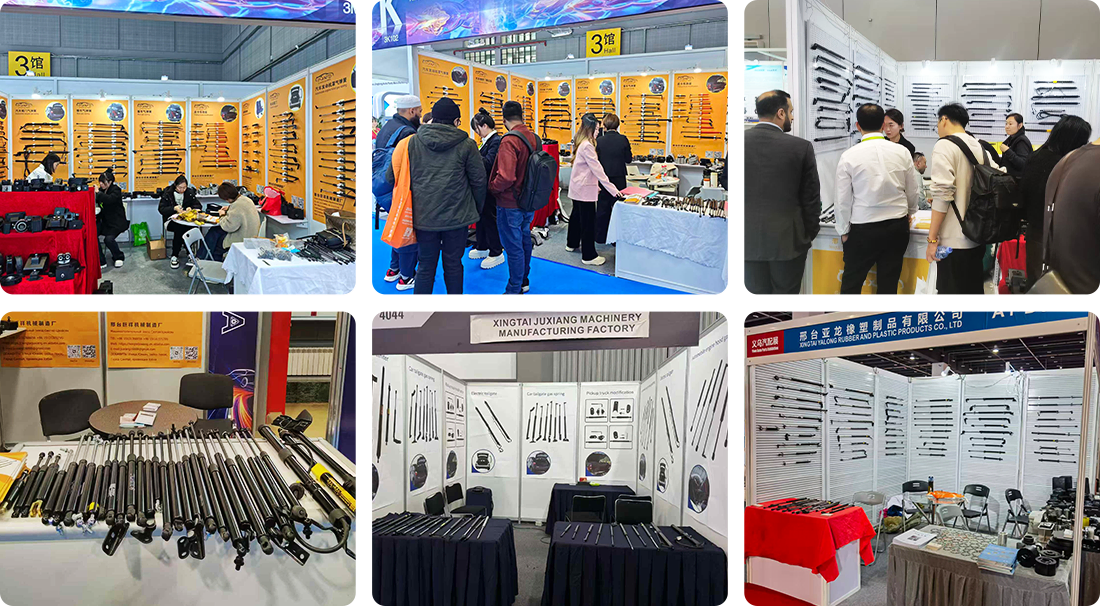
Whether you are sourcing for a specific vehicle platform or building a private-label product line, flexible customization is available. You can specify stroke length, force value, connector types, surface finish, branding, and packaging format.
OEM and ODM services cover multiple passenger vehicle and commercial vehicle models. With a workforce of approximately 100 employees and efficient production scheduling, stable delivery timelines are maintained even for growing order volumes. One-stop foreign trade support simplifies international purchasing from inquiry to shipment.
The minimum order quantity starts at just 50 PCS, making it practical to trial a new fitment or expand an existing product range without overcommitting inventory.

FAQ
Q1: Why does spring seem weaker when it is cold outside?
A: As the temperature increases, the volume of nitrogen gas drops. Performance remains constant throughout the year since units are pre-charged to operate continuously within the normal operating range of -40°C to +80°C.
Q2: When installing, should the rod face up or down?
A: It is advised to rod-down in the closed position. For effective hydraulic damping at the end of stroke, this maintains internal oil in touch with the seals.
Q3: How can I determine when a replacement is required?
A: Keep an eye out for oil leaks near the rod, a hood that will not remain open by itself, or a discernible increase in lifting effort. Failure of the seal or pressure is indicated by any of these.
Q4: Is it possible for a single unit to fit many automobile models?
A: No. Every product is adjusted to the hood weight, center of gravity, and mounting geometry of a particular vehicle. Hinge damage or safety risks can result from using the incorrect force rating.
Q5: Is painting or heating the cylinder safe?
A: Never. The cylinder is a vessel under intense pressure. A hazardous pressure release could result by heating, welding close by, or puncturing it. Internal seals will also be immediately harmed by paint on the piston rod.
Q6: What is the duration of customization?
A: Typically, standard OEM-fit components can be arranged fast. Depending on the size of the order, additional lead time is needed for custom specifications like force, length, and fittings. For a customized manufacturing schedule, get in touch with us directly.
Get in Touch
Ready to source or customize with Hood Gas Spring? Email us at jx@jxgasspring.com and our team will respond promptly with specifications, pricing, and lead time details.