Elastic Locking Gas Spring
Integrated flexible damping ensures smooth and soft movement without impact noise.
Multi-layer precision sealing reduces pressure attenuation, maintaining stable force and locking accuracy after long-term frequent use.
Dual performance of flexible buffering and rigid locking, with stable load-bearing without sliding or loosening.
Various fittings available for standard equipment and non-standard intelligent products.
Custom stroke and force for medical equipment, smart furniture and precision instruments.Minimum Order Quantity (MOQ): 50PCS
Elastic Locking Gas Spring for Medical & Furniture Applications — Smooth Adjustment with Stable Positioning
Xingtai Juxiang was established in 2002 and specializes in the manufacturing of gas springs. The Elastic Locking Gas Spring is made for situations where multi-position locking and smooth movement are necessary. Precision instruments, medical equipment, and ergonomic furniture frequently use it because of its 50N–2600N force range, 10–800mm stroke, and working temperature range of -30°C to +80°C. Our products have been shipped to Europe, Southeast Asia, the Middle East, and other regions for 20 years after undergoing comprehensive pre-shipment testing for airtightness, damping, and locking function.
What Makes an Elastic Locking Gas Spring Different?
A standard lockable gas spring holds a fixed position rigidly. An Elastic Locking Gas Spring works differently — it maintains a degree of compressible cushioning even after the internal valve closes.
This suggests that the unit may still absorb energy even when it is "frozen," thanks to the nitrogen gas charge. Under stress, the result is a yielding, pleasurable reaction rather than a violent halt. For medical positioning devices or ergonomic seating, this differentiation is essential. It protects both the hardware and the user against unforeseen peak-load stress.
In order to guaranty that the spring force remains constant and the elastic travel maintains within safe limits during the whole stroke, the boost ratio (K value) for elastic locking is kept below 1.2.
Core Technical Specifications
| Parameter | Specification |
|---|---|
| Extension Force (F1) | 50N – 2600N (standard); custom available |
| Stroke | 10mm – 800mm; customizable |
| Tube Diameter | φ15 / 22 / 28 / 40mm |
| Piston Rod Diameter | φ6 / 8 / 10 / 14mm |
| Release Pin Stroke | ≤ 3.5mm |
| Operating Release Force | ≤ 0.25 × F1 |
| Standard Extension Speed | Approx. 0.1m/s (adjustable) |
| Working Temperature | -30℃ ~ +80℃ |
| Boost Ratio – Elastic Locking | K < 1.2 |
| Boost Ratio – Rigid Locking | K < 1.6 |
| Standard Material | Carbon steel, chrome-plated piston rod |
| Anti-Corrosion Option | 304 / 316 stainless steel |
| Control Mode | Manual button / pull wire control |
| MOQ | 50 PCS |
Overall mounting length and connector types are fully customizable on request.
Key Product Features
One of this product line's most prized qualities is full-stroke free placement. There are no fixed angles or preset notches; the spring can be locked at any location within the full stroke range.
Smooth and quiet movement is guarantyd by the integrated damping mechanism. When opening or shutting, there is no impact noise, which is crucial in office and medical settings where silent operation is crucial.
Long-term pressure attenuation is decreased by the multi-layer precision sealing construction. The locking force and force accuracy are constant over prolonged, frequent use cycles. This has a direct effect on the longevity of the product and lowers the frequency of end-user replacements.
Depending on the requirements of your particular application, you can also select between unidirectional locking, bidirectional stiff locking, or elastic buffer locking.

Quality Control and Reliability Testing
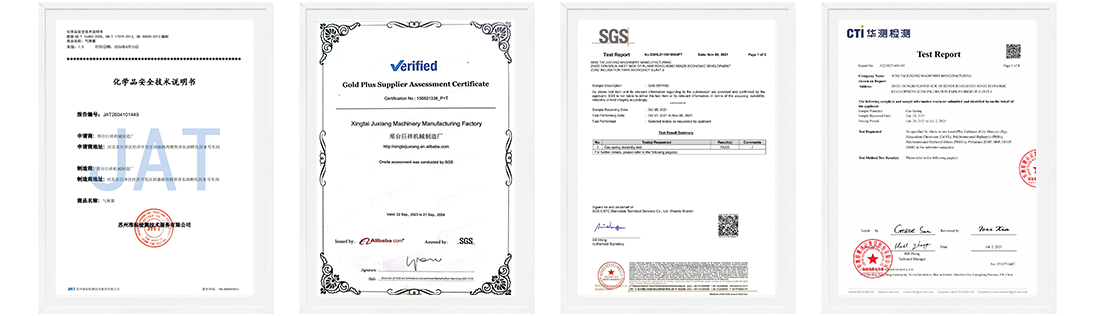
Consistent performance starts with rigorous testing at every stage of production. Each Elastic Locking Gas Spring unit is verified for airtightness and damping performance before leaving the factory.
Key quality inspection areas include:
- Cycle life testing — seal integrity and pressure retention verified over tens of thousands of actuations
- Salt spray corrosion testing — minimum 144-hour exposure to assess surface protection, especially relevant for stainless steel variants
- Locking force consistency — displacement under maximum rated load is measured to confirm elastic travel stays within defined tolerances
- Temperature performance testing — full functionality confirmed across -30℃ to +80℃
- Internal pressure burst test — cylinder wall integrity verified at pressures far exceeding standard operating conditions
These testing protocols reflect the expectations of B2B buyers in medical, automotive, and industrial sectors, where failure under load is not an option.
Customization and Supply Capabilities
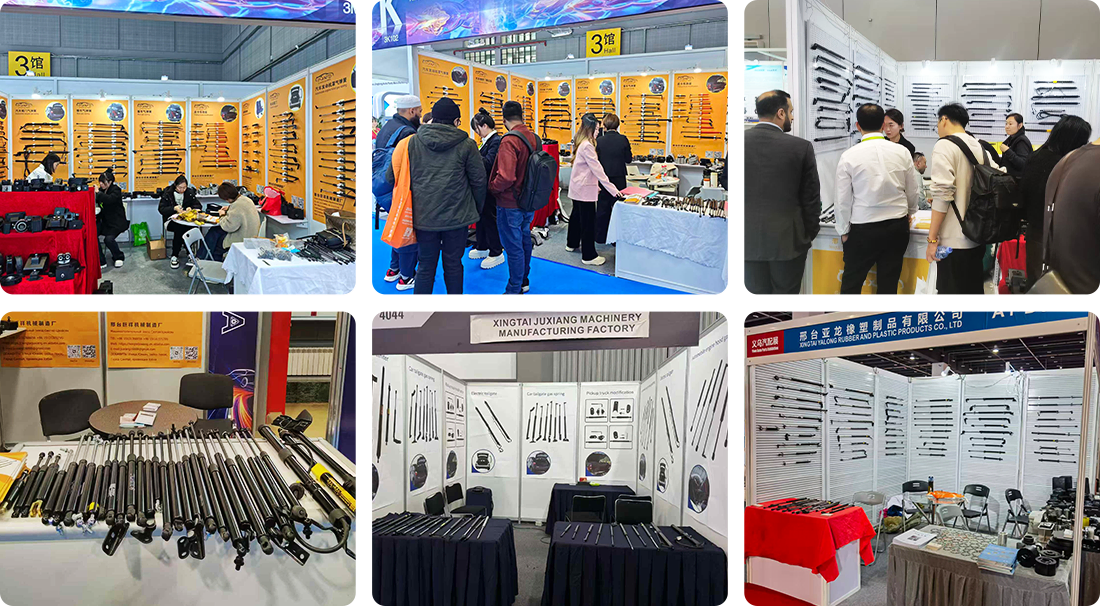
We provide full OEM and ODM customization for force value, stroke, pipe diameter, connectors and control modes. 304/316 stainless steel versions suit corrosive and hygienic environments. With stable production capacity, we support 50-piece MOQ for trial orders and mass batch production with steady lead time.

FAQ
Q1: After locking, why is there a small bounce?
A: The fundamental characteristic of elastic locking mechanisms is the buffer cushioning that the nitrogen gas offers after locking, reducing load impact and safeguarding equipment structure.
Q2: How should an installation be done?
A: To ensure steady damping performance and lubricate internal seals, piston rod downward placement is advised.
Q3: What to do if the gas spring loses pressure?
A: The sealed gas spring cannot be refilled. Pressure loss will cause invalid locking and requires direct replacement.
Q4: How to confirm the suitable force value?
A: Match force based on load weight and mechanical leverage. Send your equipment parameters for our technical recommendation.
Contact Us
For sample application, custom quotation and technical support of Elastic Locking Gas Spring, please contact our team via jx@jxgasspring.com. We offer timely solutions for your B2B projects.