How to Choose a Cabinet Door Gas Spring for Outdoor Kitchens and Garages?
The appropriate cabinet door gas spring for cabinet doors comes down to matching the force, length, stroke, and material to your door weight and environment. My name is Wang Lei. I am a product development engineer, and I have been testing gas springs for outdoor kitchens, garages, and panel furniture for years here at JX. This tutorial will take you through calculating force, resisting weather, sizing up, and checking the source so you don’t have fallen doors, rusted rods, and failed batches before they get to your clients.
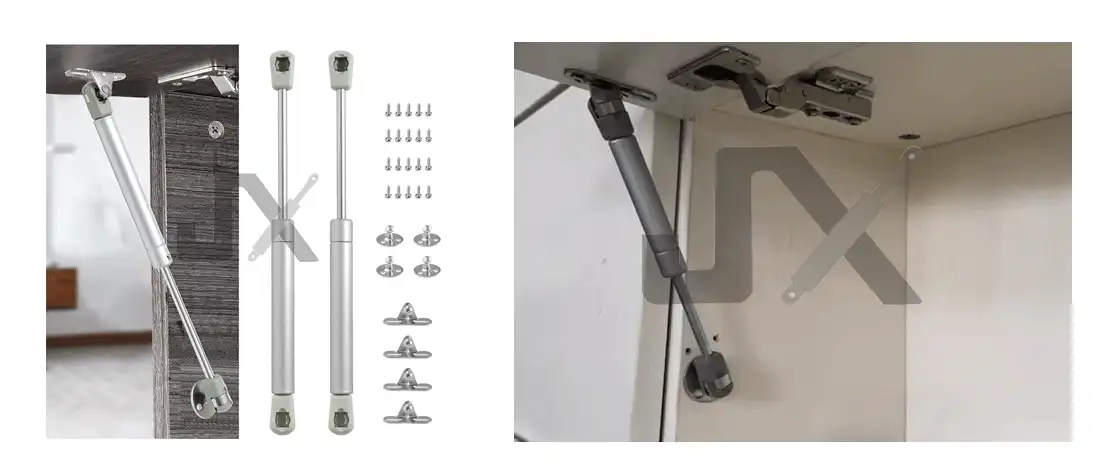
Before we get into the complete breakdown, here’s a brief reference checklist:
- Cabinet door gas springs support upward-opening doors with compressed nitrogen gas in a sealed cylinder.
- Choose spring force to match door weight, door mounting geometry, and number of springs placed.
- Materials resistant to corrosion and sealed construction are required for outdoor kitchens and garages.
- In humid or salt air conditions, stainless steel often performs better than coated steel.
- Ask for cycle test data, force reports, and material certifications before you buy in bulk.
- Standard MOQ for a trial order is usually 50 PCS for most force values.
These points cover the quick response. The next parts go through the logic so that your buying staff can justify the choice to management, customs, or a customer behind a cabinet door.
What Is a Cabinet Door Gas Spring Used For?
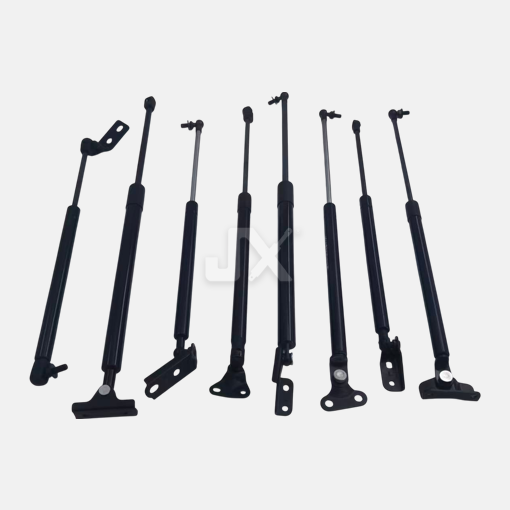
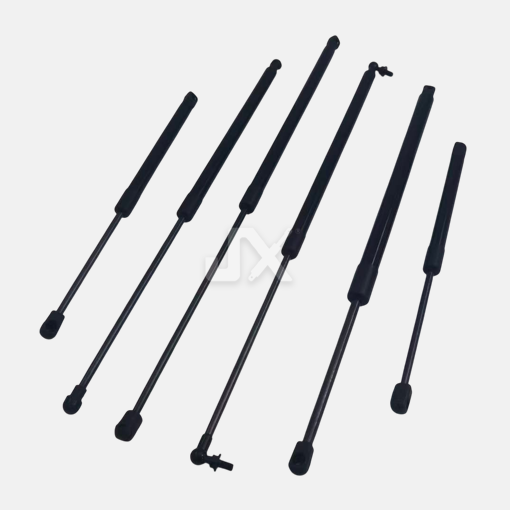
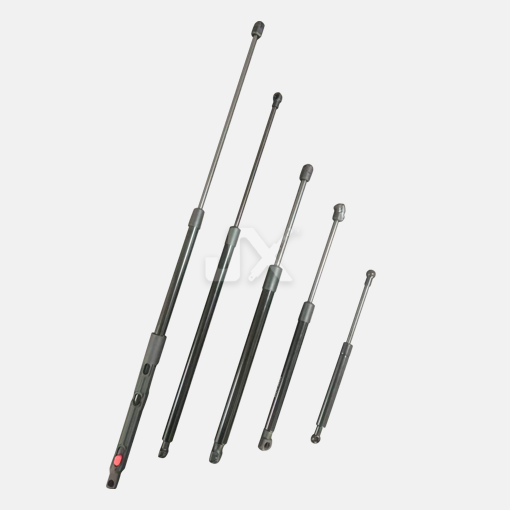
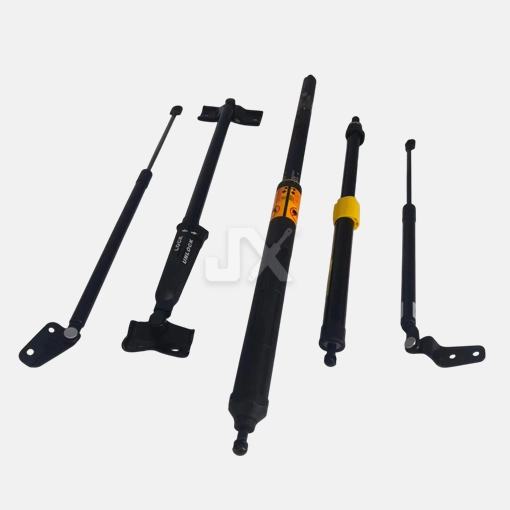
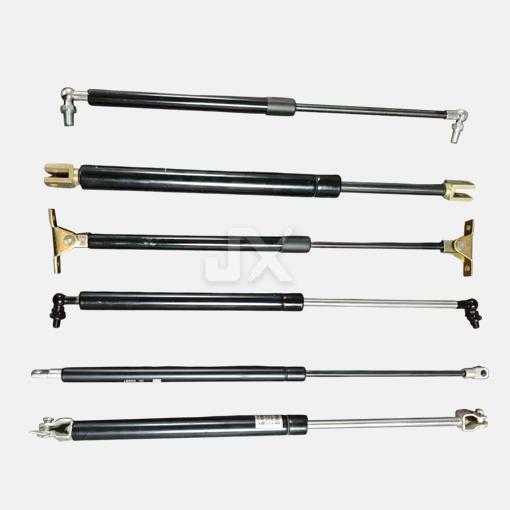
A cabinet door gas spring is a cylinder that helps open doors. It is also known as a lift support or gas strut. No lock, hinge, or electric part moves. Plus, it works with locks to make opening and shutting doors simpler and safer.
Cabinet Door Gas Spring Definition and Core Parts
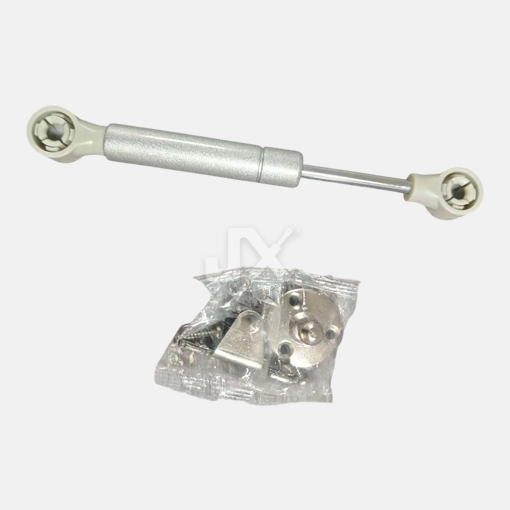
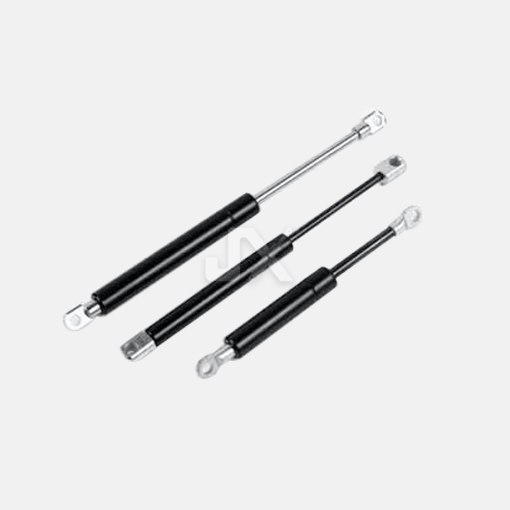
Each unit has a metal cylinder, a piston rod, pressurized nitrogen gas, internal seals, and end fittings that attach to bolts on the door panel and cabinet frame. To open the door, the gas within must force the piston rod out. That force will remain the same for some time, but only if the seal is good. Most consumers don’t understand how significant it is until they start looking at other firms.
How a Cabinet Door Gas Spring Works
When the door closes, the gas pressure increases, squeezing the piston rod into the cylinder. As you open the door, the pressure gently goes away. This allows the rod to extend and raise the panel. A “cabinet door gas spring” slows the door down as it travels the final few centimeters. So it doesn’t strike the cabinet frame. Close the door. Get someone to assist you in raising it. Keep the door open. Close the door gently.
Typical Cabinet Applications
The concept of lift support is used in flip-up kitchen doors, tool bins in the basement, electrical wall panels, and service hatches for vehicles. Here's how three distinct purchasers utilize it:
- OEM furniture producers simply plug in standard force values into flat-pack kitchen and wardrobe production lines, ordering in thousands with fixed stroke and bracket specs already suited to their door templates.
- Wholesale distributors supply common force ratings, such as 80N, 100N, and 150N, as replacement kits, selling them separately to repair shops and retail chains that require rapid turnaround on worn hardware.
Workshop owners and installers repair one failing strut on a storage bed or lift table. Usually without technical blueprints, they use measurement and visual match instead.
Why Use Gas Springs for Outdoor Cabinets?
Weather may harm outdoor kitchens and garage storage boxes in ways that it never does to inside furnishings. This option is more crucial than a bedroom closet, since the hardware will not survive as long if it becomes heated, filthy, damp, or greasy.
Operational Benefits for Daily Use
If the cabinet door gas spring is set up right, it takes less effort to open a cupboard door. Keeps the door open while you cook or collect tools. Keeps the countertop and your hands from being injured by abrupt drops. In 2024, JX surveyed 85 bulk purchasers from Southeast Asia and Central Asia and discovered that “door slamming complaints” were the key reason they lodged a warranty claim before switching to dampers with struts. Once the alteration was made, the line item had nearly 60% fewer comments after only two refilling cycles.
Outdoor Kitchen and Garage Requirements
How frequently and how wide the doors are opened, how thick the walls are, and how much room there is all figure in. When you cook outside, you combine cleaners and grease film. It makes it worse for moving parts, and dust can get into the piston rod if tools are close together in a workshop. Each kitchen has its own operating hours. The kitchen on the seaside is open 40 times a day. The garage in the heart of the country is open two times a week.
Risks and Mitigation Checklist
Look at how things are normally broken before you choose a force value or material grade:
| Risk | Likely cause | Mitigation |
|---|---|---|
| Door drops unexpectedly | Insufficient force or gas loss | Recalculate force and inspect both supports |
| Corrosion | Poor material or coating selection | Specify stainless steel or validated protective coating |
| Door binds | Incorrect mounting geometry | Check alignment and pivot movement |
| Brackets pull out | Weak cabinet substrate or fasteners | Reinforce mounting points and verify pull-out strength |
| Door opens too quickly | Excessive force or poor damping | Select suitable force and soft-close configuration |
What makes it likely to happen? What could be done to make it less likely?
- The door just seems to come off. There might not be enough gas loss or force. Find the force again after checking both supports.
- Corrosion, the wrong choice of material or covering, and the need for stainless steel or a proven safeguard.
- The parts that hold the door together are not the right shape, so it won't open. Check how the line and pivot move.
- The cabinet base or bolts are weak when brackets come loose. To fix this, make the fixing points stronger and check how well they can hold the weight.
- Just click on "Force" and "Soft-Close" to find the right force and soft-close for your door.
Gas Spring vs. Hinges: Which Works Better?
A lot of people who want to buy a door ask if a hinge is enough or if a hydraulic lift is better for a heavy door. Since you asked, it depends on how big the door is and how much help you need to close it.
Gas Spring, Hinge, Hydraulic Lift, and Support Stay Comparison
| Component | Primary function | Lifting assistance | Position support | Typical limitation |
|---|---|---|---|---|
| Cabinet hinge | Rotates the door | No or limited | Usually no | Does not support door weight alone |
| Gas spring | Assists lifting and holding | Yes | Yes, depending on geometry | Requires correct force and mounting |
| Hydraulic lift | Controlled lifting and damping | Yes | Often yes | May cost more or require specialized hardware |
| Support stay | Holds or limits door position | Usually no | Yes | Manual operation may be required |
When Gas Springs Are the Better Choice
The cabinet door gas spring works best for doors that slide open and need help being lifted. It also works well for doors that need to stay open. This includes tool chests with access panels, garage storage that hangs from the ceiling, and most kitchen shelves that flip up. If the door is heavy or more than 60 cm wide, it needs two matched springs instead of one to open. This is because opening the screen can be twisted if you put one unit out of place.
Soft-Close and Fixed-Force Options
Fixed-force cabinet door gas springs provide the same amount of resistance during the whole stroke. This is a good solution for kitchen and closet doors when the door weight is consistent. The latter portion of the walkway travels more slowly with soft-close or damped patterns. For example, retailers may let a consumer drop the door in the showroom and see it fall gently rather than come crashing down. The resistance may be adjusted on the worksite via instruments capable of changing the force. Some of our workshop customers ask us for this when they are manufacturing bespoke furniture lines, and the door weight varies from batch to batch.
What Gas Spring Force Does a Cabinet Need?
A lot of people who are new to importing get the force number wrong. The door will feel heavy or even fall if you don't push it hard enough. It will open quickly, even if you don't mean to, if you use too much force.
Cabinet Door Gas Spring Force Calculation
Follow this simple step to get a better idea:
F = (W × D) / (N × L × S)
It is written as F, which stands for "cabinet door gas spring force." It also says how much the door weighs, W, in newtons. D is how far the hinge is from the door's center of gravity. There are N gas sources. L stands for the fixing lever arm that works. There is also a safety or shape factor S that was carefully picked. It gives you a general idea, not the exact answer. The real number changes because of friction, the door's center of gravity, and the angle at which it is fixed. Because of this, the prototype still needs to be checked out before it is made.
Force Selection Examples
Ratings like 80N, 100N, 150N, and 200N are common on the market. It's possible for a 100N spring to not always work with a 10 kg door if you place it in different ways. To be safe, choose the least amount of force that will keep the door shut but not so weak that it's hard to close by hand.
Gas Spring Force Selection Checklist
Before you pick a force number for a new cabinet line, think about these things:
- Door weight, including handles, trim, insulation panels, and any attached accessories that add mass beyond the bare panel.
- Door height, width, thickness, and the approximate location of the center of gravity relative to the hinge line.
- Number of cabinet door gas springs planned and whether left and right mounting positions stay symmetrical across the panel.
- Desired lifting angle, fully open position, closing resistance, and how often the door will be opened per day.
- Safety margin built in for temperature swings, since gas pressure drops slightly in cold weather and rises in heat.
- Prototype testing at both the minimum and maximum temperatures the cabinet will face in its destination market.
—The door's weight, which includes the handles, the trim, the insulation panels, and anything else that is attached to the bare panel and makes it heavier.
How tall, wide, and thick the door is, as well as where the door's center of gravity is in relation to the hinge line.
— How many gas springs are planned, and will the left and right screws stay in the same place on the whole panel?
— The amount of lift you want, where you want the door to be when it's fully open, how hard it is to close, and how many times a day it will be opened.
When it's cold outside, gas pressure drops a little. When it's hot outside, it rises a little. To make up for changes in temperature, this is done.
It is important to try the sample in both the coldest and warmest places where the cabinet will live in its final home.
How Does Outdoor Weather Affect Gas Springs?
The weather is often the first thing that leads to a claim dispute. If you use a cabinet door gas spring outside for a few months after it worked well in a dry store, it might break.
Environmental Factors That Reduce Service Life
If you leave it exposed to heavy rain, fog, salty air, cleaning agents, oil, etc., the rod or cylinder might corrode at an accelerated rate. The outside seals degrade more quickly than the inside seals due to exposure to UV radiation and environmental variations. A 100N cabinet door gas spring at room temperature could be weaker sometimes when it is chilly outdoors. This may occur if the temperature of the gas changes. If anything doesn’t belong or collides with something, it might contribute to the environmental failure routes.” That’s because it stresses the opposite side.
Outdoor Durability Test Considerations
The resistance of various items to corrosion may be measured using salt spray studies under ISO 9227 or ASTM B117 according to the International Organization for Standardization (2017) and ASTM International (2019). Before you start the test, you need to know the specific load, stroke, temperature, speed, mounting orientation, and condition that will cause it to fail. For everything marketed as water-resistant or dust-resistant, the test method must be specified. Never trust an IP rating without viewing a report generated for that unit.
In JX, we test our rubber seals to known loads, opening and shutting them up to 50,000 times. Our formula works in temperatures from -40°C to +85°C and loses less than 5% air over 12 months. First, folks from Russia and Central Asia wanted that range to make sure it would function in the cold temperatures before they placed a huge purchase.
Weather-Resistance Decision Checklist
There should be something that says “outdoor-rated” on it, but be sure the material is weather-appropriate:
- Coastal or marine environment: Insist on stainless steel and demand salt spray test certification before approving.
- Covered garage: Coated steel may be a good choice provided humidity is controlled, and chemical exposure is restricted.
- Outdoor kitchen: Grease, cleaners, direct heat, dampness, and numerous daily operating cycles.
- Cold climate: Check low-temperature force retention and seal flexibility to projected minimums.
Installation at high temperature: The local summer peaks must be compared with the operational temperature range given by the manufacturer.
Chemicals coated on steel could be okay in a garage with a roof, as long as they don’t get too wet.
Which Gas Spring Materials Resist Corrosion?
What a cabinet door gas spring is made of can tell you how long it will last outside, but buyers who want to save money often don't do this.
Stainless Steel vs. Coated Steel
| Material or finish | Advantages | Limitations | Suitable applications |
|---|---|---|---|
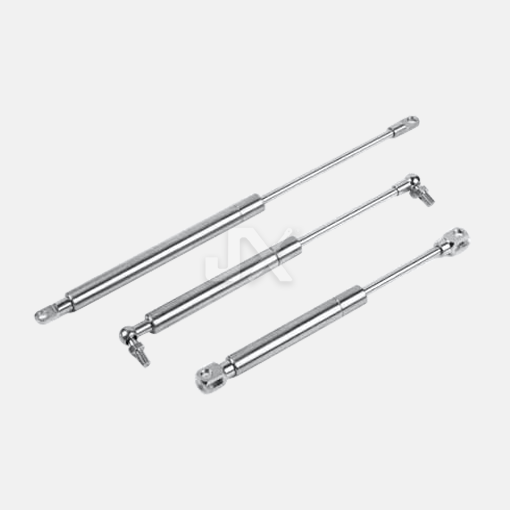
| Stainless steel, such as 304 | Good general corrosion resistance | Higher cost than standard steel | Outdoor kitchens, humid cabinets |
| Stainless steel, such as 316 | Improved resistance to chlorides and coastal exposure | Higher material cost | Marine or salt-air environments |
| Zinc-plated steel | Economical and widely available | Limited protection after coating damage | Indoor or protected garages |
| Powder-coated steel | Color options and added surface protection | Damage can expose base metal | Covered outdoor and industrial cabinets |
| Black oxide or basic plated steel | Low cost | Generally weaker outdoor durability | Dry indoor applications |
Material and Finish Verification
Make a list of the exact grade of material, rod finish, cylinder finish, seal material, clamp material, and so on that you want. You don't have to guess; compare when you have their word or good proof. Check to see if "stainless steel" means the whole thing or just the rod you can see. The frames made of plain steel will rust, even if the cylinder is fine. Words like "stainless finish" and "anti-rust coating" are only used in ads until they are backed up by a document.
EU and US Compliance Notes
Comments on RoHS and REACH are highly crucial when anything is delivered into the EU. These are compounds that cannot be used in plastics or plating (European Commission, 2024; European Chemicals Agency, 2024). The finish may be subject to Prop 65 in California and other similar regulations, but it is contingent upon where it is going and what it is composed of. For the most part, closet hardware does not have to meet FDA requirements, unless it is anything that touches food directly. Whether the cabinet door gas spring has to be CE marked depends on the machine or furniture it is fitted to.
How Do You Choose the Right Gas Spring Size?
More often than not, freight is sent back because of mistakes in size. People do this most of the time because they only measure one size and think the rest will fit.
How to Measure a Cabinet Door Gas Spring
There are eight ways to measure an existing or proposed installation: the extended center-to-center length between mounting points; the compressed center-to-center length; the stroke length (extended length minus compressed length); the cylinder diameter and piston-rod diameter; the door opening angle and available clearance; and the installed orientation, such as whether the rod points downward when stored.
Cabinet Gas Spring Size Comparison
| Specification | Why it matters |
|---|---|
| Force in newtons | Determines lifting assistance and door stability |
| Extended length | Controls maximum mounting distance |
| Compressed length | Determines available closing clearance |
| Stroke | Controls movement range |
| End fitting | Must match brackets and pivot hardware |
| Rod diameter | Affects strength, buckling resistance, and durability |
| Cylinder diameter | Influences force capacity and package size |
| Mounting angle | Changes effective lifting force |
Replacement Compatibility Checklist
Before you purchase new parts, make sure they have the same force, increased length, stroke, end fittings, and fixing location as the previous ones. Determine if you need to replace one or both springs. Mixing old and new springs doesn’t necessarily equal the lift. Make sure cabinet bolts are good before you put in a new strut. Even the nicest new item might be made weak if the holes are worn out or the brackets are twisted. What you see isn’t always what you get. Two cylinders may seem the same, yet their stroke length and striking rates might be very different. To ensure it is doable, submit a photo of the length and force range you require. Then the workshop will create a model.
What Stroke Length Fits a Cabinet Door?
You can tell how a door works by its stroke and how far and smoothly it swings when you mount it.
Stroke Length and Lifting Angle
The stroke is the distance that the piston rod goes from being fully stretched to being fully squeezed. Stroke changes not only where the door opens, but also how far it can go. The angle is determined by the door's shape, the stroke, and where the hinge and fixing points are located. Before you pick a part number, make sure the door can open to the right level without the cabinet door gas spring going too far.
Cabinet Door Gas Spring Mounting Position
The gas spring should be placed where the rear of the frame is robust and has space to move. If the doors are broad and the springs match, you cannot move the panel while it is in use. This indicates that the left and right fixings should be equal. You may alter the strength of the door by shifting the fixing point close to or away from the hinge. This switches the arm of the lever. It is crucial not to load from the side, twist or not line up the frames appropriately. Also, do not allow the moving cylinder to contact the hinges or the walls of the cabinet.
Geometry Validation Checklist
Doing a quick check pass before getting the tools out will save you time and work in the long run:
- Model or physically mark the closed, partially open, and fully open positions on a sample door before finalizing bracket locations.
- Check cylinder and rod clearance through the entire movement path, not just the start and end positions.
- Confirm the gas spring doesn't bottom out mechanically before the door reaches its intended closed position.
- Confirm the door stop, rather than the gas spring itself, limits the final movement wherever that's practical to design.
- Build a prototype with temporary brackets before committing to final drilling or production tooling on a full batch.
Make a model or mark the door so that it is closed, partly open, and fully open before you decide where to put these.
– Make sure there is enough space between the rod and the cylinder all the way through, not just at the beginning and end.
– Make sure the gas spring doesn't bottom out so the door doesn't close all the way.
—If you can, make sure that the door stop stops the end from moving, not the gas spring.
Before you drill or make tools for a whole batch, use temporary clamps to make a test piece.
How Do You Install a Cabinet Door Gas Spring?
The stuff and the people putting it together are both safer when it is put together right. This is very important on a factory line that makes a lot of things every shift.
Cabinet Gas Strut Installation Guide
To make sure each unit is up to par, you must do the following: mark where the mounting points will go on the cabinet drawing or template; reinforce any thin metal, wood, composite, or hollow panels that feel weak; install brackets with the right fasteners and tightening torque; attach the cabinet door gas springs without forcing or bending the rod; test the operation slowly through the full opening and closing range; and make sure the door stays in place, closes evenly, and symmetrically before moving on to the next unit.
Installation Safety and Quality Checks
Do not utilize a gas spring that has been removed to keep the cabinet door open during installation. Instead, utilize a driven support. Test out of the hinge and clamp pinch. Install the same size and shape gas springs on either side of a broad door. When working with piston rods, ensure that they are not contaminated with dirt, welding dust, or sharp edges. People may not realize how soon a scratched rod bearing can go bad. Record specific mounting positions, installation torque, and inspection findings for each set of parts. This will help you discover the data after the event. If there is a claim.
Common Installation Errors
People who say they offer guarantees often get things wrong. People sometimes use too much force because the mounting point doesn't give them enough leverage, put the rod down on the gas spring when the design calls for it to be up, attach brackets to weak material without making it stronger, let the gas spring act as the hard door stop instead of having its own stop feature, and use springs with different force or damping ratings on the same door.
When Should You Replace a Cabinet Gas Spring?
For most people, a door that rusts, falls off, or makes strange noises is reason enough to get a new one. But you need to know why you're replacing it so you can pick the right part.
Why Cabinet Door Gas Springs Fail
Worn-out seals or a broken piston rod can cause cabinet door gas spring leaks. Corrosion can happen on the rod, cylinder, brackets, or end fittings. An overloaded door or extra accessories can also cause side loading. Ball sockets that are worn out or mounting hardware that is loose can also cause side loading.
How Long Do Cabinet Door Gas Springs Last?
It's not just the number of cycles; the load, the climate, the temperature, the rod safety, and how well the fitting is made affect how long something lasts. A cycle test report from the manufacturer that shows the load, stroke, speed, temperature, and conditions under which the joint failed is a good thing to ask for as specs. There should be stricter rules for cabinets that are outside or that are opened a lot than for cabinets that are inside and are only opened a few times a week. In a controlled lab setting, we tried standard-grade units that are meant to be used in a home kitchen. They kept their force within the range for 30,000 to 50,000 cycles. But in real life, the weather where you live and how well the unit was set up are what matter.
Replacement Inspection and Procurement Process
It's time to get a new gas spring if the door moves awkwardly, falls off on its own, the force clearly goes down, there are leaks around the rod seal, or the rod surface is rusty. If two units show different amounts of force or age, you should change both of them at the same time. The door tilts when it's open because the springs aren't lined up right. Before you place your order, write down the model, its length, stroke, force, type of fitting, material, and how it should be put together. Before you decide to buy, you should also think about the MOQ, the wait time, the payment terms, the Incoterms, the packaging, the coverage of the guarantee, and the amount of specific information that is available.
Supplier Capability and Evaluation
It is not enough to look at the cost of a cabinet door gas spring. More than that, check out. Look for companies that can help with engineering for force calculations and custom mounting geometry, produce standard, heavy-duty, stainless steel, and soft-close models, keep records of quality from incoming inspection to final testing, provide OEM or ODM support with private labeling and packaging control, and have experience in exporting with the appropriate datasheets, certificates, and Incoterms.
You may check out JX right away to determine whether it belongs on our list. The Xingtai factory in Hebei Province began production in 2002. There are around 100 people working there; 20 of them are professionals in science and business. It produces its own electric tailgate struts and gas springs; no components are sourced from others. The goods are in compliance with ISO 9001, GB/T 25751-2010, QC/T 207-2021, and ISO 11982. They are cultivated in more than 40 sites in Southeast Asia, Turkey, Russia, South America, and the Middle East. The delay is normally between 20 and 30 days; ERP plans the manufacturing. There is a book with more than 5000 kinds and a 2-year warranty. Don’t only take the word of a provider; there are alternative methods. Check factory audit records, test samples, and model-specific reports.
Quality Verification and Traceability Table
Eight types of proof should be shown before you agree to a big sale:
| Verification item | Evidence to request |
|---|---|
| Force accuracy | Force test report at defined temperature and stroke position |
| Dimensional conformity | Inspection report for length, stroke, rod, cylinder, and fittings |
| Cycle durability | Cycle-test method, load, speed, temperature, and result |
| Corrosion resistance | ISO 9227 or ASTM B117 report when applicable |
| Materials | Material certificate or supplier declaration |
| Batch traceability | Lot number, production date, and inspection record |
| Packaging | Drop, moisture, labeling, and carton specifications |
| Warranty | Coverage period, exclusions, and replacement process |
Compliance, Logistics, and Documentation
Make sure the EU RoHS and REACH statements are correct for the products you are using and the market they are going to before you ship them. Read about the US rules on drug imports, marking, and telling people what they are used for. ICC rules say to use clear terms like EXW, FOB, FCA, CIF, or DDP, but only after both parties know what their responsibilities are (ICC, 2020). You should always ask for a business statement, a packing list, help with HS codes, proof of origin, a datasheet, and test results when you buy a package of documents. Say right away how many of each model you need to place an order, how to buy mixed models, how long it takes to make, how long it takes for trials, and how much it costs. Last but not least, don't just compare prices per unit; also look at how much it costs to ship everything. It costs money for things like fits, shipping, taxes, inspection, and maybe even having to buy a new item.
Talk to Our Engineering Team Before You Order
If you get the force number or material kind incorrect, it will cost you a lot to send additional containers out. JX will be providing free power estimations for anyone building their own retail brand. Sample kits and private-label packaging are also available starting at 50 pieces. Send an email to jx@jxgasspring.com with the weight, size, and the names of the people you want to purchase the door. In two business days, we’ll let you know what size line we believe you should acquire for your outdoor kitchen or garage.
Conclusion
The price of a cabinet door gas spring is not the only thing to consider. Also inspect the power, length, stroke, mounting form, material, bike life, environment, and documentation. Cabinets outdoors, in places like sheds and kitchens, are affected by weather in ways that cabinets inside never are. For this reason, test results for strength and resistance to corrosion are more relevant than a slightly lower unit cost. Follow the procedures in this article, acquire authentic test findings, and sample a tiny bit before you purchase the full item.
FAQ
1. What is a cabinet door gas spring?
A cabinet door gas spring is a pressurized lift support that assists upward-opening doors and helps hold them open. It works with hinges and mounting brackets rather than replacing them.
2. How do I calculate gas spring force for a cabinet door?
Estimate force from door weight, center of gravity, mounting distance, lever arm, and the number of gas springs installed. Because geometry strongly affects real-world performance, validate the final selection through prototype testing before mass production.
3. Is 100N or 200N better for a cabinet door?
Neither rating is better by default. The correct choice depends on door mass, dimensions, mounting position, opening angle, and whether one or two gas springs support the panel.
4. Are stainless steel gas springs better for outdoor kitchens?
Stainless steel gas springs generally resist corrosion better in humid, coastal, and frequently washed environments. Confirm the actual grade used and whether brackets and piston rods are also made from corrosion-resistant material.
5. How do I measure a replacement cabinet gas spring?
Measure extended center-to-center length, compressed length, stroke, force rating, cylinder and rod diameters, end fittings, and mounting orientation. Also inspect the cabinet brackets and mounting-hole dimensions before ordering a replacement part.
6. Why does a cabinet gas spring fail prematurely?
Common causes include corrosion, gas leakage, side loading, incorrect force selection, damaged piston rods, weak brackets, temperature extremes, and door overloading beyond the rated weight.
7. How long do cabinet door gas springs last?
Life depends on cycle count, load, temperature, environment, seal quality, and installation accuracy. A reliable supplier should provide cycle-test data using defined load, stroke, speed, and temperature conditions rather than a generic lifetime claim.
8. Can one gas spring support a heavy cabinet door?
A single gas spring can support a door when the force and mounting geometry suit the panel. Wide or heavy doors often need two matched gas springs to balance the load and avoid twisting during operation.
Request a Sample Before Your Next Container Order
Dropped doors and rusted brackets usually trace back to a skipped sampling step, not a bad factory. JX supplies private-label packaging, custom force values, and documented cycle testing for distributors and OEM furniture lines across Southeast Asia, Africa, South America, Russia, and Central Asia. Looking for a dependable cabinet door gas spring supplier for your next trial order? Reach out to jx@jxgasspring.com with your target force range and destination country for a quote.
References
1. International Organization for Standardization. "ISO 9227:2017 — Corrosion tests in artificial atmospheres." 2017. https://www.iso.org/standard/68420.html (cited in weather durability section)
2. ASTM International. "ASTM B117-19 — Standard Practice for Operating Salt Spray Apparatus." 2019. https://www.astm.org/b0117-19.html (cited in weather durability section)
3. International Organization for Standardization. "ISO 9001:2015 — Quality management systems requirements." 2015. https://www.iso.org/standard/62085.html (cited in supplier evaluation section)
4. European Chemicals Agency. "Understanding REACH." 2024. https://echa.europa.eu/regulations/reach/understanding-reach (cited in materials compliance section)
5. European Commission. "RoHS Directive — Restriction of Hazardous Substances." 2024. https://environment.ec.europa.eu/topics/waste-and-recycling/rohs-directive_en (cited in materials compliance section)
6. International Chamber of Commerce. "Incoterms 2020 Rules." 2020. https://iccwbo.org/business-solutions/incoterms-rules/ (cited in logistics and documentation section)
About the author: Wang Lei is a Product Development Engineer at Xingtai Juxiang Machinery Manufacturing Factory (JX), where he works on gas spring force calculation, seal design, and cycle testing for furniture, automotive, and industrial clients. He has supported OEM sampling and material certification for distributors across Russia, Central Asia, and Southeast Asia for several years.