Coffee Table Lift Gas Spring
Integrated damping buffers impact, preventing sudden lifting or dropping for quiet and safe operation.
Precision sealing reduces pressure attenuation, maintaining stable force after frequent operation.
Compact size and easy installation, suitable for panel coffee tables and multi-functional household furniture.
Various fittings available for standard tables and customized furniture assembly.
Custom force and stroke for lifting coffee tables and multi-functional desk manufacturing.Minimum Order Quantity (MOQ): 50PCS
Coffee Table Lift Gas Spring for Adjustable Furniture — Smooth Lift, Silent Operation & Custom Solutions
A Coffee Table Lift Gas Spring is a precision hydro-pneumatic component that transforms an ordinary coffee table into an ergonomic, multifunctional surface. Xingtai Juxiang Machinery Manufacturing Factory, founded in 2002, brings over two decades of gas spring engineering expertise to furniture hardware. These parts offer steady, well-controlled pulling performance with a force range of 300N to 1500N, strokes from 30 to 500mm, and extended lengths from 150 to 1500mm. They can work in temperatures ranging from -40°F to +80°F because they are made of solid steel tubes and chrome-plated piston rods. This makes them effective in a wide range of climates and settings around the world.
What Makes This Coffee Table Lift Gas Spring Different?
Noise, uneven resistance, and rapid drops are all problems that come with standard coil spring doors. A lift gas spring that was made just for the job fixes all three issues in a single small unit.
The built-in damper buffer reduces the pressure at the end of the stroke, which keeps the tables from slamming shut or opening quickly. For the safety of the user and to protect the joints of furniture over years of daily use, this is important.
Precision internal sealing greatly lowers pressure loss, so the force output stays the same even after thousands of rounds of opening and closing. Once you use it once, and again for months, you get the same smooth lift.
Technical Specifications
| Parameter | Value |
|---|---|
| Extended Length | 150 – 1500 mm |
| Stroke | 30 – 500 mm |
| Force Range | 300N – 1500N |
| Piston Rod Diameter | Ø6 / 8 / 10 / 12 mm |
| Tube Outer Diameter | Ø15 / 18 / 22 / 27 mm |
| End Fitting Options | Ball joint, Eye, Clevis |
| Tube Material | Seamless steel tube |
| Rod Surface | Chrome-plated |
| Working Temperature | -40℃ ~ +80℃ |
| MOQ | 50 PCS |
These parameters cover a wide range of panel coffee tables, lift-top designs, and multifunctional furniture assemblies. If your project falls outside standard ranges, custom configurations are available.
Core Performance Advantages
Hydraulic damping controls movement speed in both directions and reduces operating noise. The tabletop stays fixed at any lifted position without sliding down, suitable for writing or placing laptops. End-stroke damping avoids

Application Scenarios
Lift-top coffee tables are most frequently used in residential settings. Even when typing or writing, the Coffee Table Lift Gas Spring maintains the tabletop's stability when the user elevates it to laptop height. End customers start to perceive smooth, vibration-free support at this point.
Furniture with concealed storage beneath heavy wooden or stone tops is a common characteristic of small urban flats. In this case, a higher-force version properly manages the weight load, allowing for smooth repeated access without putting the user under mechanical strain.
Hotel lobbies, executive lounges, and co-working spaces are examples of high-traffic commercial settings that require components that can withstand hundreds of daily cycles while still operating silently and with a premium feel. This criterion is directly supported by the fatigue-tested construction.
The production of multipurpose desks and furnishings is an expanding B2B market. The continuous force output and wide range of customization choices available for OEM production runs are advantageous to furniture manufacturers creating height-adjustable writing tables, breakfast trays, or modular workstations.
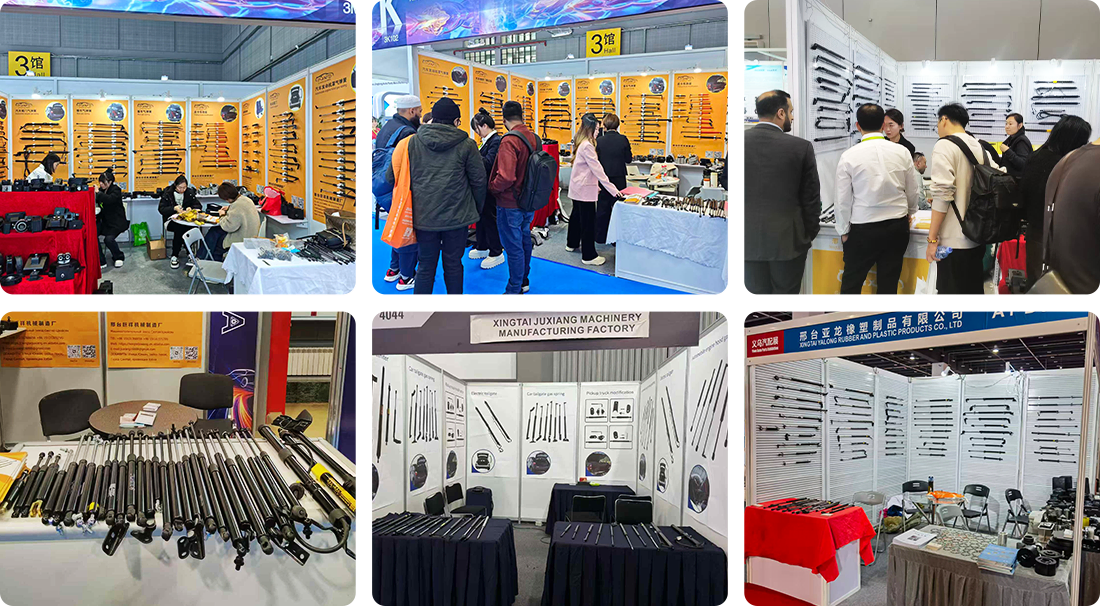
Quality Control and Reliability Testing
Before being sent, each batch of Coffee Table Lift Gas Springs is put through a series of performance tests. Strict air-tightness testing is part of this to ensure that there are no gas or oil leaks when running at maximum pressure.
To ensure that force retention and seal integrity stay within specification over time, fatigue life testing puts each design through prolonged cycles that mimic years of regular operation.
Stable damping and pressure performance across the whole operating range of -40°C to +80°C is confirmed by high and low temperature resistance testing. This is particularly crucial for goods going to export countries with harsh seasonal weather.
Force departure measurement verifies that the lifting curve satisfies the hinge geometry and tabletop weight criteria of your furniture by comparing F1, F2, F3, and F4 values to the specification. This avoids both excessive resistance and under-support.
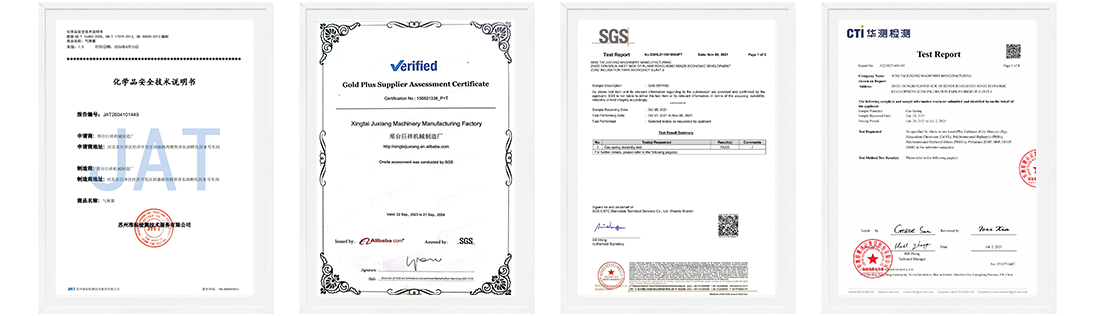
Customization and OEM Supply
Depending on your furniture design, you may choose the end fitting type, rod diameter, tube diameter, stroke length, and force value. It supports both completely customized and standard setups.
Furniture makers who require consistent component specifications during big production runs might benefit from OEM and ODM services. Before scaling, it may be used for small-batch production and initial sampling due to the MOQ of 50 PCS.
Reliable delivery scheduling and assistance with international trade documents are included in the basic service due to the company's extensive export expertise across Europe, Southeast Asia, the Middle East, and other locations.

FAQ
Q1: How to select suitable force value?
A: Calculate tabletop weight plus load and hinge leverage ratio. 300N–500N works for most medium wooden tops. Send dimensions and weight for our recommendation.
Q2: Why is the spring stiff at the first use?
A: This is normal. Internal lubrication spreads after 5–10 cycles, and operation will turn smooth.
Q3: Can a depressurized gas spring be repaired?
A: No. It is sealed high-pressure assembly. Replace it directly once pressure drops; disassembly is unsafe.
Q4: Does the piston rod need extra lubrication?
A: No external grease required. External lubricant may collect dust and damage internal seals.
Q5: What causes slamming noise while closing?
A: Usually caused by insufficient counter force. Choose higher force rating or enhanced damping models to fix it.
Get a Custom Quote
Send your furniture specifications for Coffee Table Lift Gas Spring via jx@jxgasspring.com. We will prepare a custom quote quickly.