Commercial Vehicle Gas Spring
Performance: Gas/hydraulic cushioning for silent closure; anti-corrosion; -40°C to +80°C; weather-resistant.
Maintenance-Free: Self-lubricated design; no periodic servicing needed.
Pair Replacement Advised: Always replace both sides to ensure even wear and stability.
Tool-Free Installation: Fittings pre-mounted; install instantly with common tools.
Customization Options: Travel, force, connectors, branding, packing all open to customization.
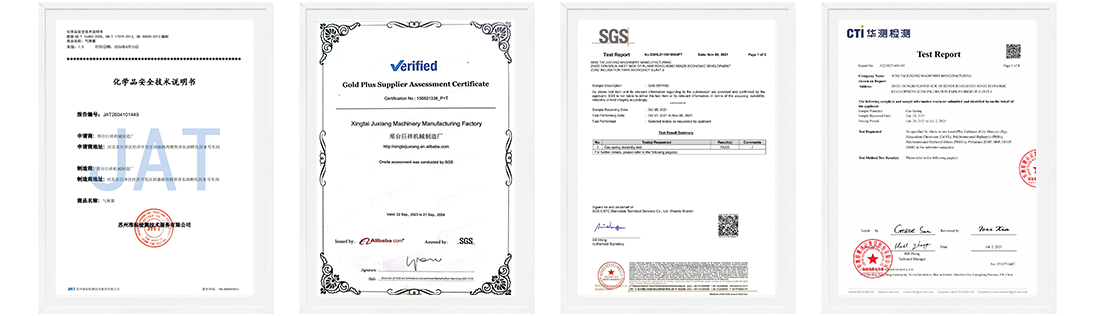
Certifications: Backed by IATF 16949 & ISO9001 standards.
Minimum Order Quantity (MOQ): 50 units per order.
Commercial Vehicle Gas Spring for Heavy-Duty Trucks & Buses — OEM-Grade Lift Support Solutions
Since 2002, Xingtai Juxiang has been developing components for precise motion control. With a working temperature range of -40°C to +80°C, its Commercial Vehicle Gas Spring series provides smooth, silent lift aid for heavy-duty trucks, busses, trailers, and coaches. Each unit satisfies OE-equivalent fitting requirements thanks to its seamless steel tube structure, QPQ-treated piston rods, and design life of more than 50,000 cycles. With complete OEM/ODM customization for stroke, force value, and end fittings, the minimum order quantity (MOQ) is just 50 units.
What Is a Commercial Vehicle Gas Spring?
A commercial vehicle gas spring is a hydro-pneumatic motion control device that controls the controlled movement of heavy structural components by using an internal oil circuit and high-pressure nitrogen gas.
Compared to standard passenger car struts, these components are specifically made for high-duty cycles and much greater force requirements. Among other useful operational concerns, they reduce the ergonomic impact on drivers and technicians, absorb vibration stress during long-haul operations, and stop massive cargo doors from slamming uncontrolled.
These components, like a truck engine hood, a coach baggage hatch, or a trailer cargo door, are more than just mechanical add-ons; they are instruments for effectiveness and security.

Technical Specifications
| Parameter | Details |
|---|---|
| Material – Tube | Seamless steel tube |
| Material – Piston Rod | QPQ-treated high-strength carbon steel |
| Working Temperature | -40°C to +80°C |
| Force Range | 50N to 5,000N+ (customizable) |
| Design Life | 50,000 – 100,000 cycles |
| Salt Spray Resistance | ≥144 hours (ISO 9227) |
| Fitment Type | OEM direct-fit, vehicle model matched |
| End Fittings | Ball joints, eyelets (customizable) |
| MOQ | 50 units per order |
| Quality Standards | IATF 16949, ISO 9001 |
| Customization | Stroke, force value, connectors, branding, packaging |
Quality Control Process
Every unit of Commercial Vehicle Gas Spring goes through a multi-stage inspection process aligned with IATF 16949 requirements. This is not a final-check-only approach — quality is controlled at every stage of production.
Testing for force characteristic curves compares P1, P2, P3, and P4 results to engineering requirements. This guaranties that the force-displacement ratio is accurate and constant throughout each batch.
Every design is put through more than 50,000 cycles at rated load during endurance cycle testing. Throughout the test, engineers keep an eye out for structural wear, damping deterioration, and gas leaks.
For cars working in coastal, northern, or industrial regions, salt spray and corrosion tests confirm that the piston rod and outer tube can tolerate road salt, chemicals, and humidity during prolonged running periods.
Helium leak detection is used in seal integrity studies to verify long-term pressure retention. In commercial fleets, seal failure is the most frequent source of field problems, and this stage is regarded as a crucial control point.
Burst pressure testing ensures the unit is safe even in extreme heat events by validating the pressure tube's safety factor against gas expansion under unusual circumstances.
Application Scenarios
Heavy-duty engine hoods require substantial and consistent lift-assist force. These gas springs provide reliable stay-open support for large truck hoods, keeping them safely raised during roadside maintenance — even in high-wind conditions.
Logistics trailer cargo doors and loading ramps operate in extremely high-frequency environments. Gas springs here must deliver effortless door movement and end-position damping to prevent structural damage during rapid unloading cycles. Durability and consistent force output are non-negotiable.
Bus and coach luggage compartments face a unique challenge: frequent passenger use, high dust exposure, and large hatch surface area. Gas springs for these applications often incorporate locking mechanisms to prevent accidental closure on busy terminal platforms.
These three scenarios represent the core B2B demand drivers — and each one requires a different combination of force value, stroke length, and damping specification. Customization capability matters here.
Customization & Supply Advantages
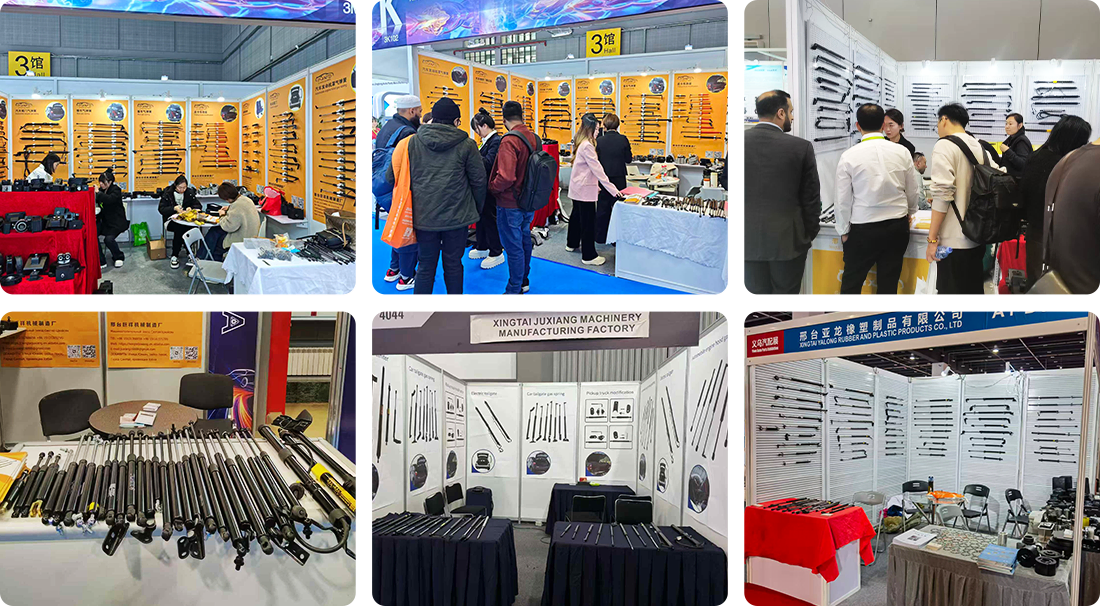
You can specify stroke length, force value, end fitting types, surface coating, branding, and packaging format. OEM and ODM orders are both supported, with experience across multiple passenger and commercial vehicle platforms.
Production scheduling is efficient, with stable lead times and one-stop export support. Whether you are sourcing for a single vehicle model or a multi-platform fleet program, the factory can accommodate your requirements starting from 50 units.

FAQ
Q1: Why does the spring feel weaker in cold weather?
A: Gas pressure follows Charles's Law — for every 10°C drop in temperature, force decreases by approximately 3.3%. If your vehicles operate in extreme cold, specifying a higher initial force value at the time of ordering is recommended.
Q2: What is the difference between hydraulic and dynamic damping?
A: Hydraulic damping relies on the rod-down orientation to move oil through the piston. Dynamic damping uses a longitudinal groove in the tube wall, providing more consistent speed control regardless of mounting angle — better suited for variable-orientation installations.
Q3: Can the spring be installed with the rod pointing upward?
A: Standard designs perform best in the rod-down position, as this keeps internal seals lubricated by the oil. Rod-up installation is possible for certain custom designs, but should be confirmed before ordering.
Q4: How do I know when replacement is needed?
A: Watch for visible oil residue on the piston rod, increased manual effort needed to lift the component, or slamming during the final closing phase. These all indicate that damping oil has escaped and the unit needs replacement.
Contact Us
Ready to source reliable lift support solutions for your fleet with Commercial Vehicle Gas Spring? Send your vehicle model and requirements to jx@jxgasspring.com — the team will respond promptly.